Awesome new video from Mike & Mike's Guitar Bar featuring some of the best vintage Japanese Fuzzes ever made!
Check it out here//
thanks for watching,
-ed

Check it out here//


So I thought it might be cool to map out this evolution, and explore the lexicon of fuzz...

While the word "fuzz" had been used since the dawn of radio to describe a poor or noisy signal, and later to describe a faulty or overdriven amplifier, it doesn't seem to have been widely applied to an intentional guitar tone until 1961, with the now legendary release of Marty Robins' Don't Worry from January of that year.
Shortly after, the earliest gear nerds were already asking "HOW did he get that sound!?" And the article above, from January 22nd 1961, gives a really cool snap-shot into this world; describing the exciting (and confusing) "new sound" that guitarist Grady Martin used for the track.
Additionally, mentioned towards the end of the blurb, was that Martin had just released a brand new instrumental track of his own called The Fuzz, that he apparently made after realizing this very unique and "new sound" could disappear at any moment.


This past Summer I was probably spending too much time going through old magazine archives and looking for anything pedal-related. My main years of focus where 1962-1972, as the later half of that decade saw the birth of guitar pedals, and specifically FUZZ, as we know it today.
And as it turns out, I was very lucky in tracking down some really important ads and articles that have helped clear up much of the history we all thought we knew for the past couple decades. Additionally, I was able to discover some pedals that were completely new (to me), which then lead to even more digging and late-night research.
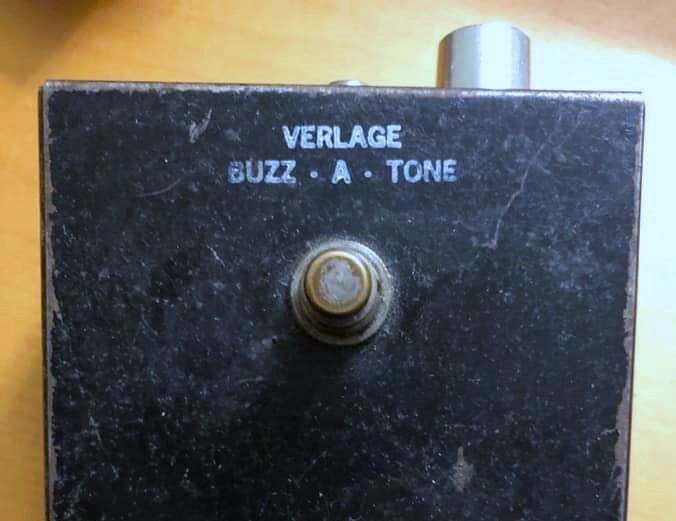
The article below, which was found in the June 1969 edition of The Music Trades magazine, highlights a "new" fuzz out of Saskatchewan, Canada called the "Buzz-A-Tone". As you can imagine, I immediately had to find out everything I could about this thing, and see if I could track one down for myself (spoiler alert: I didn't). So here we go! This is everything I have found, so far, about the Verlage Buzz-A-Tone fuzz...


The majority of their 70s lineup featured rugged plastic enclosures with a logoplate glued to the end. They put out pedals like the Phazer, Power Driver, Wah Fuzz Swell, and Sustain. But the real standout was their Fuzz King (which was a redesigned Supa Tonebender).
By the late 70s they began to migrate away from plastic and over to large black metal enclosures. This new series featured an Equalizer, a Phaser, and a new Flanger that sounded as though it was handed down from intergalactic travelers or something...

By 1980 things seemed to change for Electronic Sounds, and a new series of equally large metal enclosures were introduced; featuring the Phazer, Sustain, and these two gorgeous monsters; the Flanger and the Fuzz King!
Each pedal from this line came in a cool color and made a massively bold statement. I can only imagine a pedalboard full of new Electronic Sounds effects in 1981 and how it would look like you're piloting the Nostromo. 🚀

This appears to be the final set of effects that Electronic Sounds would produce, and my best guess is that they closed up shop around 1982.
Which is a total bummer because these all look so awesome! But I also get it, in terms of what guitar players wanted by then; which was Boss, MXR, and DOD-sized units that could easily be thrown in a gig bag and taken anywhere.
With the relatively short window of production and the regional aspect of mostly being sold in Italy, this final series of Electronic Sounds is extremely rare. I have only seen a handful of Sustain and Phasers, even less Flangers, and this is only the 2nd Fuzz King I have ever seen in my 20+ years of collecting!


