Thursday, July 31, 2025

Baby Fuzz / Distor Wha (70's France)

☟
Continuing on with our vintage French pedal features (see the Garen Distortion post here), today we're going to take a look at the Baby Fuzz / Distor Wha. As we mentioned in the last post, quite a while back we highlighted the mysterious Baby Fuzz. Once thought to be of Japanese origin, it turned out to be a French built Vox/Jen Distortion Booster copy from (most likely) 1970 or so. As of now it is the only one I have ever seen, and I thought it had the potential to be either homemade or some kind of local electronics shop kit. But a couple of years ago I came across photos of an odd fuzz/wah I had never seen before. I did however, immediately recognize the font and what it was called...


The Baby Fuzz apparently had a big sister called the "Distor Wha". And luckily for us about a year after discovering this existed, another one popped up online and we got even more photos. 

After looking it over, it clearly uses many of the same components found in the Baby Fuzz, and even uses that same heavy grip tread. Additionally the font used on the input and output jacks "Guitare" & "Ampl." are identical to the font used on the Baby Fuzz.

So I think it is safe to say, they were made by the same manufacturer.


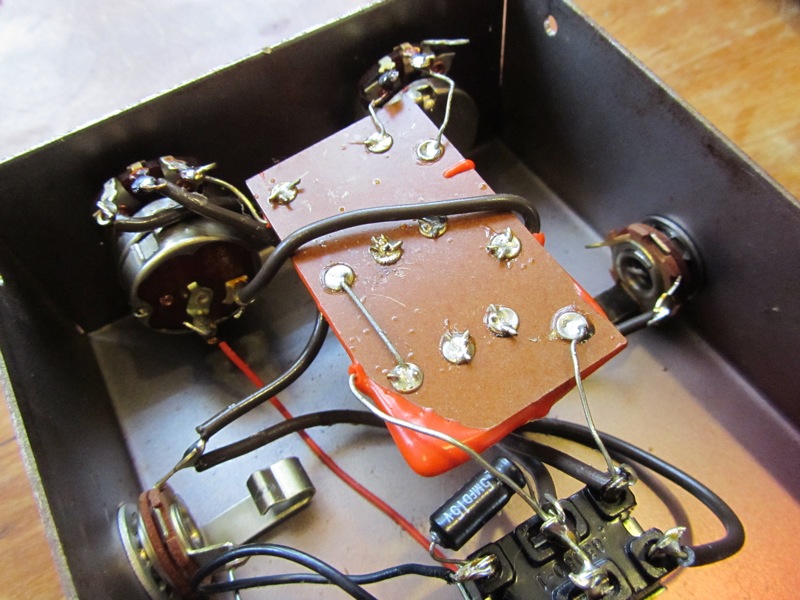
When comparing the two, while I am not anything close to a pedal builder (at all), it does seem very likely that both pedals use the same fuzz circuit. In addition to all of the components being the same (minus the transistors, which could be explained by simply one pedal coming before the other), it also used the right amount of those components.

Unfortunately we still don't know who manufactured these.  But the best clue we have can be found on the bottom of the PCB of the Distor Wha. Etched in, it clearly says "France" and above that we have a bit of an enigma to unravel... "ER_B" So what does that obscured letter say? "D"? "R"? "B"?

We may never find out, but I'm hoping that someone reading this will immediately recognize it and comment on how stupid I am for not knowing basic French vocabulary. :)


So if nothing else, we finally have confirmation that the Baby Fuzz (and now the Distor Wha) was actually of French origin! So that's an exiting end to an almost 15yr mystery.

I'd still love to find out who was making these, mostly because they teeter right on the edge of a one-off garage project, and a small "boutique" level of production. But I could be way off, and maybe they were being put out by some larger French amplifier brand at the time? (finding an original advertisement would be amazing! Were there any French Rock magazines in the 60s/70s I should be digging through?)


One of my favorite things about getting into the pedal history weeds is realizing that way more countries were building pedals during that golden era than we ever gave credit to. Just over the last 6 months I have seen pedals I never knew existed from places like Turkey, Romania, Poland, Indonesia, Chile, and Korea.

Each of these have a cool story to tell, individually and as part of the larger story of Distortion (which to me is the most important discovery in all of modern music).

So as always, we seek to discover more and more. And if you happen to have any additional information about the Baby Fuzz line, please feel free to reach out  via Email or Instagram

thanks for reading,
-ed

Monday, July 28, 2025

Garen Fuzz - Chambre De Distorsion (1969)

☟
By the late 1960s the sound of gritty primitive fuzz had fully captured the French youth. In addition to music trends coming out of the US and UK, new Garage Rock and Blues Rock bands were popping up in France all the time (highlighted well in this recent video by Yesterday's Papers). Many of these bands were using pedals made outside the country or homemade one-offs by local solder jockeys, but we also know of at least two truly French fuzz pedals made during this time; the somewhat mysterious Baby Fuzz (we highlighted years ago in THIS POST), and the Garen "Chambre De Distorsion".


Garen Electronic Music Instruments MFG. was mostly known as an amplifier brand, based in Paris and started by Jean Guen around 1958. And I would go into more depth about their history, but it's so well laid out in this website run by Guen's own grandson, that I highly recommend going through all of their awesome photos and detailed info if you really want to go extra deep. But to skip ahead for the sake of this post; with the rise in popularity of Rock & Roll in France, Garen decided it was time to capitalize on the moment with a new line of amps and their own take on both reverb units and the new 'hip' fuzz sound sweeping the nation.


So in 1966 the Garen Distortion was born! Coming in a super sleek, polished chrome wedge enclosure with a cool 3-way tone switch, it stood out among the onslaught of foreign fuzz pedals invading Europe during the 60s. With an unexpectedly simple design, based more on basic transistor theory than on any specific fuzz pedal, the Garen Distortion was something unique that proud French players could call their own. 

Built like a tank with the engineering precision of a NASA rocket, it also stood wayyyyyy out in terms of quality for the 1960s. Everything from the wiring to the battery door was constructed with an attention to detail rarely seen in the vintage effects world.

It might not translate over photos just how well these are made, but trust me! These things are solid, and ready to last another 50+ years.


The circuit itself runs off three germanium transistors, and while the majority used are unlabeled, at least one unit has surfaced with AC182's.

And like we said a second ago, it doesn't appear to borrow directly from any other fuzz at the time. The basic design has instead been described as three cascading gain stages followed by a selectable filter (you do see a similar circuit concept in the elusive Liverpool Fuzz, but a connection between the two is impossibly unlikely).


The selectable filter is really unique though, and offers quite a range of tones. The first setting gives a nice fat, but still hairy 60s style fuzz. The middle position actually boosts the midrange, giving you a more focused but again, still fairly aggressive fuzz tone. And the final setting is the closest to that classic crispy icepick FZ-1A tone we all love but with a bit more gain on tap.

I can't think of many other contemporary fuzzes that had filter/tone sections quite like this, except maybe the GM Fuzz Up FD3 and obviously the Honey Baby Crying Fuzz (and all its offshoots). Otherwise it was a pretty novel way to dial in your tone at the time. 


While these are fairly rare outside of France, they aren't impossible to find. That being said, for a long time I was under the impression that the Garen Distortion was only available during 1969. I had seen three different units by this point, all hand-dated to 1969 (including the one I now own), plus the 1969 catalog from earlier in this post. 

But then a "1966" labeled pedal surfaced, an undated unit with "67" codes on the capacitors was next, and finally a really odd unit with a serial number on the back that could possibly indicate it was made in 1970! So I can't say with 100% certainty that they were originally released in 1966 and made through 1970, but as of now that's my best guess.

photo by: Rafmax


The Garen Distortion is definitely more of a fuzz, and soundwise I would put it comfortably in the Maestro FZ-1 family. That being said, it offers a lot more gain than an FZ-1, and maybe lies a little closer to the Tone Bender end of this imaginary spectrum.

Luckily for us though, we don't have to worry too much about getting the adjectives right because our friend Rafmax made a demo of my 1969 unit back in 2014. Check it out below!


Even though most of the pedals we write about here are steeped in mystery, the Garen fuzz has been pleasantly easy to research (and I greatly appreciate that!). So although we still don't know exactly how long they were being made, how many were made, and if they actually appear on any of those 60s French fuzz records, I can appreciate that we're much further along than we typically are by then end of these posts.

So I hope you have enjoyed this one! And if you happen to own a Garen "Chambre de Distorsion", I would love to know what date is on yours, and if you could send a photo of it, that would be even more awesome! :) Please feel free to reach out via Email or Instagram, and I hope you have an awesome week.


Thanks for reading,
-ed

Saturday, July 19, 2025

Early Shin-ei Advertisements

☟
From the very beginning of my vintage pedal journey I have been captivated by the Japanese effects giant, Shin-ei Electric. It was one of (if not THE) first company I ever legitimately researched, after seeing what was clearly a dominating amount of pedals they produced throughout the 70s. The endless OEM brandings combined with three of the most classic effects of all time (Uni-Vibe, Super Fuzz, FY-2) made the history of Shin-ei a super intriguing topic for my ocd nerd brain.

But unlike the vast majority of US pedal manufacturers that were relatively easy to research, the more layers I peeled, the further away I got from learning who was behind Shin-ei and what their actual connection to pedal history was. To this date, we (well, I ) still don't know any names of anyone who worked for what has to have been a huge factory (and one that ran for at least a decade). Nor do we know if they actually designed any of the effects they built. Nor do we know something as simple as how a foreign brand, like Apollo, would have found out about Shin-ei and hired them to produce gear with their logo attached...

So today we continue with what I've been able to find over the past couple of years, with a little help from some friends over in Japan. We have 3 advertisements (all from 1969, I believe) that show Shin-ei in a moment of transition, from "Shin-ei, the manufacturer of microphones and pickups", to "Shin-ei, the manufacturer of guitar effects and more". As far as I know, none of these have been available on the internet until now :)


Above is the original ad, and below is the Google translated version (probably not a perfect translation). This is from the early Spring of 1969 and shows Shin-ei advertising an entire line of various pickups. 

It is currently believed that they had been around as early as the late 1950s, manufacturing pickups for the various Tokyo-based guitar companies.

One thing to note is that we see no mention of effects pedals or Companion as a brand. This doesn't necessarily mean anything, but I feel like it's important enough to point out.


This one, dated to April of 1969, is special because by all accounts Honey had gone bankrupt just a month prior. And I had long held the belief that Shin-ei produced the Honey effects, but recently I've come across some big evidence that tells a different story.

The small blurb at the end of this ad reads, "A specialized manufacturer of guitar microphones, vocal microphones, and transformers". To me, this implies that they did not yet manufacture effects pedals. 

Related to this, is the 1968 Honey catalog that contains a line of microphones. A big part of me thought that if I could just match up the mics sold by Honey that were also sold by Shin-ei, then I would crack the code! Unfortunately, there were zero matches...


This one is important! And while I unfortunately don't have a specific date attached to it, my assumption is that this ad is from some time in mid-late 1969.

The Companion logo is different than any we've seen on any effects we know of. Additionally, we see our first pedal, that appears to be a wah. But while it is similar, it's actually like no other Companion branded wah known to exist. The treadle portion with the small arrows pointing to the input and output jacks, we have seen before in the earliest run of Surf Siren Wahs. So what I believe we're seeing in this ad, is the very likely the first Shin-ei/Companion effect pedal.

Another important part of this ad is the phrase: 
"We can produce a microphone based on your design, even if it is just one unit."
This says to me that they have now officially entered the world of Original Equipment Manufacturing, and are willing to work with companies as large as Hohner, or as small as Mana (see this article on many of the different brand badges found on Super Fuzzes).

I had previously stated that I hadn't found any evidence that Companion existed as a brand before March of 1970. And while I don't have a specific date on this final ad, the handful of clues it does provide would make it appear that possibly by the end of 1969 Companion was in and Honey was out. And Shin-ei Electric was on the precipice of becoming the largest manufacturer of Japanese effects for the coming decade.

*One thing I would like to point out is the article we put up a couple months ago regarding the Japanese Wedge Fuzz. In there I posit that Shin-ei did NOT produce the famous Sekova wedge fuzzes, even though they did have a relationship later on. If what we're seeing in these ads is proof that they didn't start manufacturing effects until the second half of 1969, then it would have been impossible for them to have made the wedge fuzzes.

thanks for reading,
-ed

Tuesday, July 1, 2025

DOD 201 Phasor - The First 3 Years

☟
For vintage DOD heads, there may be no grail holier than pedals from the very first "big box" series, circa 1974-1977. As we discussed super at length in a No Demos video on the history of the 250 Overdrive Preamp (HERE), the earliest official DOD pedal was the black Electronic Phasor. Well it must have seemed like a great idea, because from that moment through 1980 they would use phase shifters as their flagship devices to herald in new lines or variations on existing effects.

So today we're going to look at the pedal that was born right out of those original big box Phasors and its exponential evolution through the first 3 years of production... 

DOD 201 Phasor Phaser Phase Shifter

At the beginning of 1977 DOD introduced a new, scaled-down line of effects. It was called the "200 Series" and featured the now infamous "Bud Box" enclosures. They were the first DOD pedals with a smaller footprint and an attempt from the brand to follow the trends of the time.

In keeping with tradition, the first effect they released was the 201 Phasor. It was a completely redesigned circuit from their previous two phase shifters, taking cues instead from the MXR Phase 45.

Like all of the pedals from that series it featured an off-white finish, 3-D brand logo, and that fancy old westy font.

It's believed that these were built for just a few months, making them quite rare and hard to track down nowadays. So if you find one (or currently own one) let me know! :)

DOD 201 Phasor Phaser Phase Shifter

In the Fall of 1977 DOD was ready to release their brand new updated "200 series" pedals. Following legal threats from MXR, they ditched the Bud Box enclosures and created their own unique sand casted units.

Again, the first effect they would choose as the introduction to this new series would be their 201 Phasor. Now cloaked in grey paint with bright yellow graphics and that big bold 3D brand logo, DOD would unknowingly release what would become one of the most iconic guitar pedal lines of all time.

The circuit remained roughly unchanged, with the biggest difference being a new larger PCB, giving the parts room to breath without all the constraints of a Bud Box enclosure.

DOD 201 Phasor Phaser Phase Shifter

In early 1978 DOD again changed the look of their pedals, but this time it was purely graphical. Along with the 250 Overdrive Preamp and the 280 Compressor, the new 201 Phasor would shift to a smaller DOD brand logo and a thinner font.

The pedal was otherwise identical inside and out. And this would be the last era of DOD effects that were battery powered only (note the lack of a 9v jack on the side of this and the previous two versions).

Not quite as rare as the two models above, but this version is still considered somewhat of a "hen's tooth". Amazingly though, it's often overlooked as it's easy to miss the no-power jack.

DOD 201 Phasor Phaser Phase Shifter

Toward the latter half of 1978 DOD again revised their 200 Series effects, giving the customers what they wanted... a power jack!

Visually this version looks almost identical to the previous one, and it is, except the added jack on the side above the output. Inside, as is with the 250 and 280, there is an update to the circuit that simply accommodates the new wall power (affecting the tone slightly, but noticeably).

These are fairly common to find on resale sites, and to the point that if you can't find one, just be patient... you will.

DOD 201 Phasor Phaser Phase Shifter

The final version of the gray 201 Phasor came out in 1979, and on a technical level, is the same as the previous version (although you will find differences in component brands, just like all DOD pedals).

The biggest difference here is the graphics were changed to highlight the various jacks; "Out", "In", and the brand new "PWR." were placed within the borderlines themselves. This again is an updated feature you will see on most of the 200 Series effects from this era.

These are the most common gray 201 Phasors you will come across. And although I didn't get into serial numbers, this version has the widest range.

From here, DOD would continue to expand their phase shifting repertoire, and go on to release the 401 Phasor, the 490 Phasor, and the 201 Phasor in yellow all within a year of each other. And while the gray 201's lifespan was relatively short, it serves as the perfect example of a young company pushing forward, figuring it out as they went along, and just making it work!

So if you have any additional details on the history of DOD, or if you happen to have one of the first two Phasors discussed above, please feel free to reach out to me via Email or Instagram, I'd love to hear about them.

thanks for reading,
-ed

Saturday, June 28, 2025

Rosac Nu-Fuzz - The Chaos of Order.

☟
The Nu-Fuzz holds a special place in pedal history for being the true successor of the legendary Fuzzrite. As the story goes, it was designed by Ed Sanner and originally intended for Mosrite as an updated version of their best/only stompbox. But when things began to get a little rocky in the Fall of 1968, Sanner decided to look for opportunities elsewhere.

Oddly enough a connection to the Sierra Bag Co. through Semie Moseley would be the perfect platform for Sanner to spread his perfectly soldered wings. Together with trumpet player Ralph Scaffidi, Sierra Electronics was born. Their first product was the Nu-Fuzz and it was released in the beginning of 1969. 

And even though that narrative has been consistent throughout the years, it's still a bit unclear exactly how and when it all happened. But with the help of some equally nerdy pedal friends, and after doing some heavy research of my own, I think we could potentially get a little closer to the full truth, and clear up (at least some of) the story of the Rosac Nu-Fuzz...

Rosac Nu-Fuzz History

The first slice of new/concrete info I was able to find on the Nu-Fuzz is what appears to be its earliest mention in print, from February 26th 1969! But instead of being an ad for the Sierra Nu-Fuzz, it's actually an ad for what we believe to be an OEM partnership with Don Wehr's Music City in San Francisco.

The Wehr Fuzz-Tone was something of a modified version of the Sierra Nu-Fuzz (which you'll see in a minute). But otherwise, it was the same pedal but with the "Wehr" logo and branding.

Rosac Nu-Fuzz History


Rosac Nu-Fuzz History

Rosac Nu-Fuzz History

And if introducing your new pedal company to the world immediately with a licensing deal sounds weird... I agree! But we'll try to tackle that a little later. For now, let's focus on this February start date. If it really is the true introduction of both Sierra Electronics and the Nu-Fuzz, then it's quite possible that the Wehr Fuzz-Tone is the very first version... 

But the "Sierra Electronics" labeled Nu-Fuzz, which has always been thought of as the initial Rosac product, most likely did come first. And in fact, I have found at least two examples of Sierra Nu-Fuzzes with a different style of knobs that are not found on any other Sierra/Rosac product. Also, if we take into account the circle graphic around the pots, it would seem very likely that the design was done specifically for these smaller knobs, as opposed to the typical skirted style you find on the vast majority of Nu-Fuzzes. This could possibly suggest that the pedals with these particular knobs were the very first units to roll off the production line (a theory I quite like); but it could also mean nothing. lol

Rosac Nu-Fuzz History

The full history of Sierra/Rosac has been well documented in the past, due in large part to Bart from FXDB  (check it out). But as we stated above there are some updated and completely new pieces of the puzzle that have surfaced since 2009. 

So here's the quick abridged version before we really get in the weeds; in 1947 Ben Sacco and Morris Rosenberg started the Sierra Bag Company in Bakersfield, CA. With a few additional ventures already under the "Sierra" umbrella, they decided that they wanted to enter into the burgeoning electric guitar market (this was either in 1965 or 1968). It was then that "Sierra Electronics" was born; and while the details aren't quite clear, it's possible that there was even an early connection to fellow Bakersfield, CA instrument company, Mosrite; either through the fact that both companies were located only 3 miles from each other and their owners became friends, or deeper (yet unknown) business dealings.
 
New information from a former Rosac shop manager has revealed the possibilty that BEFORE making effects Sierra Electronics had originally focused on small solid state amps and guitars (but that has yet to be verified). And toward the end of 1968 Ed Sanner, designer of the Fuzzrite, was connected to Sierra owners Sacco and Rosenberg by a mutual friend, Ralph Scaffidi. Scaffidi and wife/legendary guitarist Mary Osborne had recently moved to Bakersfield from the East Coast and through a friendship with Semie Moseley became friends with Sacco. 

Sacco, who was head of the Bakersfield Italian Heritage Association, took a quick liking to Scaffidi. So when he and Sanner proposed adding effects pedals to Sierra's output and starting a new brand, Sacco was all in. The idea was to essentially fill the void that would be left in the wake of Mosrite's departure. This venture would take on the Sierra Electronics name, and as we noted earlier, their first product would be the Nu-Fuzz.

Rosac Nu-Fuzz History


Rosac Nu-Fuzz History

Well let's get back to the pedals themselves! One thing is for sure, since the very beginning they came in a variety of colors (Red, Gold, Green, and later, Silver), with the Sierra version coming in at least two different paint finishes, shiny and matte (although it's looking like only the very first Nu-Fuzzes produced used the matte paint).

The other thing we can say as fact, is the circuits in the first Nu-Fuzzes used silicon transistors and were constructed on eyelet boards covered in orange "goop". The Wehr Fuzz-Tone and the Sierra Nu-Fuzzes both featured this build-style.

*this is also a very similar construction to a pedal we highlighted on the blog a while back, the mysterious Pro Suzzzz Fuzzzz.

Rosac Nu-Fuzz History


Rosac Nu-Fuzz History

Another part of the Nu-Fuzz lore that you're most likely familiar with is that, according to Ed Sanner, some time in early 1969 Sierra Electronics was hit with a 'cease and desist' from fellow California-based Sierra Electronic Corp, out of Menlo Park.  

The resulting name-change is what you're probably most familiar with, "Rosac Electronics & MFG. Co.", taken from the combination of Rosenberg and Sacco, the owners of the company. (not unlike "Mosrite" that came from combining the names, Semie Moseley and Ray Boatright) 

Sanner has stated that it was only for a single month, but it is unclear precisely how long they were operating as Sierra Electronics. And of their full pedal lineup, only Nu-Fuzzes under that "Sierra" branding have ever surfaced (so far). This suggests that it was still fairly early on in 1969, as is evident from a newspaper ad I found from May of that year for a Nu-Wa, which potentially confirms that the Sierra name only lasted one or two months. And this could also be the reason we can't find anything in print regarding the name "Sierra Electronics".

Rosac Nu-Fuzz History


Rosac Nu-Fuzz History

Rosac Nu-Fuzz History

Toward the middle of 1968 Mosrite decided to contract out the manufacturing of the Fuzzrite circuit to Massachusetts-based Sprague Electric. This was an agreement that seems to have been picked up by Sierra/Rosac and was used for their fuzz, wah, and even amp circuits. But in a funny turn of events, it would appear as though the first order for the circuit modules was made while the company was still called "Sierra Electronics" and unfortunately wasn't fulfilled until well after the name-change to Rosac, and even more unfortunate, it must have been a MASSIVE order.

So the first version of the "Rosac" branded Nu-Fuzz featured the "Sierra Electronics" Sprague modules, as did the Nu-Wa Fuzz and the Distortion Blender. All three were available by November of 1969, as is evident by this newspaper ad from the Santa Fe New Mexican:

Rosac Nu-Fuzz History

I can only imagine that when it came to the Sprague modules they had bins of them at the manufacturing facility, all mixed together with both "Sierra" and "Rosac" labeled circuits. I say this because they appear almost at random throughout the rest of the Nu-Fuzz run (and inside the Distortion Blenders and Nu-Wa Fuzzes).

So from here on out things get weird, and the timeline just seems to dissolve into space dust...

Rosac Nu-Fuzz History

Rosac Nu-Fuzz History

With that in mind, the main point to focus on will be the graphics. For this version of the Nu-Fuzz they decided to slightly tweak the Sierra layout, keeping the knobs on the front with the jacks on the sides, and also continuing with the "smile" Nu-Fuzz logo.

And at first glance it looks like they literally just switched out the branding from "Sierra" to "Rosac". But if you look a bit closer there are three other differences; 1, is the font on both the control labels and the logo itself changed, 2, is the small lines above the words "Tone" and "Level" in the Sierra version have been moved to above the knob, and the circle around the pot is completely gone, and 3, is the word "Off" and the little arrow next to it are different! In the Sierra version there is a line at a sharp angle coming from the bottom of the word "Off", and in the Rosac version both the arrow and the word "Off" are curved (this is also seen on Distortion Blenders).

Rosac Nu-Fuzz History


Rosac Nu-Fuzz History

For what is possibly the next version of the Nu-Fuzz, Rosac moved to a straight-line logo and a layout that seems to be adapted from the Wehr Fuzz-Tone. With the knobs located on the top of the pedal, it's much more reminiscent of a Fuzzrite (the point maybe?).

The biggest difference to the Wehr Fuzz is the pot and jack labeling; going from "Volume" to "Level", "Input" to "Instrument", and "Output" to "Amplifier".

This tends to be the most prevalent version of the Nu-Fuzz you'll come across. And I have gone back and forth about where it appears in the timeline. It's confusing enough that the possibility they were being made simultaneously with the Smile logo version is strong. Did these only exist because of a canceled contract with Don Wehr's Music City? I honestly have no clue, but it's definitely a question I have considered.

The straight-line logo Nu-Fuzzes also featured both "Sierra" and "Rosac" labeled Sprague modules. And even the pot dates are of little help, as they range from 1968-1969, just like the other versions.

Rosac Nu-Fuzz History

Rosac Nu-Fuzz History

And to make things even more convoluted, Rosac, the sadists they were, threw in a couple more curveballs, most likely just to mess with nerds in the future who try to do what we're doing right now.

First is the example below. It's clearly a Sierra Nu-Fuzz enclosure, as it has the right graphics and layout. But it's completely missing the branding and it uses a Sprague module instead of an eyelet board circuit (I've actually found two units exactly like this).

There's probably a few reasons why these exist, but one could be that it was either used for a local OEM deal, or it was intended to be used for an OEM deal that fell through. Another reason, that comes from seeing an example of an unbranded one that does have the eyelet board construction, is that these were a short run of transitional units that came between the "Sierra" branded pedals and the "Rosac" branded ones. Either way, they're a cool oddity.

Rosac Nu-Fuzz History

Next, and going in the complete opposite direction, is the Nu-Fuzz below, that has the straight-line logo but features a Sierra style eyelet board circuit!

This one is super perplexing because all of the early Rosac dealer ads I have found show the smile logo version. Additionally in those ads is the earliest version of the Nu-Wa, the Nu-Wa-Fuzz, and the Distortion Blender. Suggesting the straight-line logo came last. So what the hell is up with this???

It's a total head scratcher, and I could only come with two possible reasons for its existence; 1, is that maybe it was originally built to be a Wehr Fuzz but something happened to cause it to be put aside until later? or 2, and this could explain all of the exceptions, is that many of the pedals came back in for repairs or were returned completely because of malfunctioning components. And as an ex-employee has stated, they had bins of returned pedals and parts at the factory. So maybe instead of wasting a good circuit, they simply installed it into a later-run pedal?

Rosac Nu-Fuzz History

Rosac Nu-Fuzz History


Rosac Nu-Fuzz History

Another pedal that puts just a small dent in my awesomely solid timeline is the Wehr Fuzz-Tone below. The graphics are all identical to the version we talked about earlier, but the big difference is that it uses a Sprague module! 

Now the logical conclusion is that they made the Wehr Fuzz longer than we originally thought. But when I look back through my favorite internet databases, the last ad for them I've been able to find is just from March of 1969. So from February to the end of March they advertised their new Fuzz-Tone loud and prominently. And they continued advertising in the local San Fran papers for the next two years but would never again mentioned the fuzz, at all...

Rosac Nu-Fuzz History


Rosac Nu-Fuzz History

And while these inconsistencies with the Wehr Fuzz most likely have a simple reason behind them, I'd like to postulate an option that could tie this all together with a nice little bow:

It's late 1968 and Ed Sanner sees the writing on the wall with the coming bankruptcy of Mosrite. So he contacts a couple of like-minded acquaintances (Ralph Scaffidi & Mary Osborne) with success in the music industry and ties to potential corporate backers. After some discussion with Sacco and Rosenberg they all decide to go in together and start Sierra Electronics, wasting no time building their first product, the "Nu-Fuzz" (most Sierra Nu-Fuzzes have pot date codes of November 1968).

During this time they acquire their first OEM deal with Bob Wehr's Music City, and start creating Nu-Fuzzes specifically for them as the Wehr Fuzz-Tone (I've even thought about the possibility that the Wehr contract was originally made with Mosrite but never had a chance to be fulfilled). 

Mosrite officially goes bankrupt in February of 1969 and Sierra Electronics releases the Nu-Fuzz and the Wehr Fuzz-Tone immediately afterwards, using the stock they had been building the previous few months. And because Wehr's Music City's original deal is for X amount of fuzzes, by the time the 2nd part of the order is ready, Sierra has turned into "Rosac" and they begin using the Sprague modules that have finally arrived. Unfortunately sales are poor and the Wehr Fuzz-Tone is a bust, causing the Music City to quickly abandoned the pedal upon receiving this (final) order.

This is all just pure speculation, so please don't quote the above musings as fact. But I do like to throw my best guesses up on here to get the conversation going, if nothing else :)
 
Rosac Nu-Fuzz History

Rosac Nu-Fuzz History

Some time in 1971/72 Ed Sanner decided to start his own business with Rosac plant manager, Ken Gilstrap, both leaving the company as a result. This was also after Rosac decided to abandon the standalone Nu-Fuzz pedals, as they saw them to be inferior and a costly redundancy of the popular Nu-Wa Fuzz. 

This was a decision that would mark the beginning of the end for the Rosac effects line, as they were plagued with customer complaints about the quality of the wah pedals and inundated with returns. This ultimately pushed them to focus solely on amplifiers through to their end, around 1979.

I have tried to find more information to confirm exactly how long they made the pedals, but nothing solid has come up. So as of now, the true end-date of the Nu-Fuzz will remain unknown.

So! If you happen to have any version of the Nu-Fuzz and would like to do me a huge favor :) :) :) All I am looking for are potcode dates and any photos of other weird/inconsistent ones hiding out there.

And obviously if you have any additional info on Rosac please, shoot me a message via Email or Instagram.
Thanks for reading,
-ed

*Big thank you to Nick from Fuzzboxes.org, Bart from Effects Database, Jerms, and Chris Martin for your photos and your help in doing much of the research legwork long before I got anywhere close to writing this!