Showing posts with label Plugin. Show all posts

Monday, March 13, 2023

Sekova Big Muff SE-2015 (1974)

☟
The lineage of Japanese effects is just difficult to research. Most of the available information leads you down a dark and endless tunnel system, splintering off in every direction; starting with a small syndicate of factories and ending with an almost infinite amount of brands, builders, labels, and products.

That all being said, I'm feeling pretty good about this one, and I think you may actually find a new nugget of information (or two). 
So let's go!


As I write this, the true origin of Sekova as a company is still a bit of a mystery... The further I dug into this, the more tangled it all became. But here is what we do know;  By the mid 60s a small builder based in Trumansburg, NY was producing cheap guitar amplifiers for the brand, in an attempt to capitalize on the Rock revolution (post Beatles/Ed Sullivan appearance). And this small builder, while relatively unknown at the time, would end up becoming one of the most influential minds of music technology in the 20th Century; his name, Robert Moog (yes! THAT Moog). 

What is unclear is Moog's true involvement with Sekova. Was it a guitar-based offshoot of R.A. Moog Co.? His business partner Walter Sear had been importing and distributing brass instruments to the US since the 50's, so was Sekova his idea? Or, were they simply hired to manufacture the amps, leaving the distribution to Sekova? Sadly, we don't know any of this.


But what we do know is that in this Upstate NY workshop they were making all kinds of amps, with brandings like Amper, Encore Amplifiers, and Sekova (originally named "Segova", until hit with a cease-and-desist from famed guitar player AndrĂ©s Segovia). We also know that Sekova was importing Japanese-built electric guitars as early as 1964, and Korean-built acoustic guitars at least that early.

But when it came to the amps, they were being made in the Moog "factory" in Trumansburg and then shipped to NYC, where Walter Sear and a few others would assemble them. Moog was always looking for ways to lower their costs, which eventually lead him to seeking out alternative part options overseas, from Japan. Unfortunately this would quickly come back to bite him in the ass, as they received hundreds of returns from angry customers due to the poor quality.

After a string of money-losing decisions, the Summer of 1966 also saw the demand for cheaply made guitar amps starting to wane. And the final blow to the project was the exceedingly exponential growth of competition in the amplifier market. This, combined with a strengthening Synthesizer business, pushed Moog to drop out of the guitar amplifier world for good, leaving Sekova behind in the process...


But just a year later the Sekova brand would reemerge, now fully owned and distributed by the U.S. Musical Merchandise Corp of New York, they expanded their array of guitars and accessories, and even included their first pedal, a Maestro Fuzztone copy called the No. 59 Distortion Box (discussed at great length HERE).

Throughout the rest of the 60s and 70s the U.S. MMC utilized Sekova to sell things like Les Paul copies, psychedelic picks, mandolins, autoharps and yep, amplifiers. But their biggest contribution to the guitar world was an intensely red-colored set of pedals and plugin effects (almost completely copied from Electro Harmonix circuits), with an oddly cold font choice, and completely manufactured in Japan by the Shin Ei group.


The true star of this series was 100% the no-f*cks-given named, "Big Muff". Released (most likely) some time in 1974, it was a nasty and dark-tuned version of the 1971 Triangle Muff circuit, with a size that dwarfed all the other effects in their lineup.

Sitting on a shelf this beast stares back into your soul, beckoning you to pick it up and plug it in; it's just so damn RED! And because of that, for a long time it was the subject of endless stompbox lore, rarely showing up for sale, and in the possession of only a very small group of collectors. 

Even right now you can find old forum threads asking about a strange "Red Big Muff", and was it some unknown Electro Harmonix side project forgotten by time? It wasn't until the late 2000s when a few more of these finally showed up that we began to see the light, realizing it was a Japanese-made pedal, most likely from the early 70s, by Shin Ei and distributed by Sekova.


This particular Sekova Big Muff took me about 7 years to find. 

They would rarely show up for sale, and when they did they were almost always beat to hell and rusted out. And even back then they were selling between $700-$1,000! 

But luckily for me my competition for buying vintage pedals was significantly lower in the early 20-teens than it is today. And finally, in 2011 I scored this beautiful example of the Sekova Big Muff.


So how do they sound???

Well a couple of weeks ago we posted a super in-depth demo and review of one HERE. But I'll also do my best to describe it in my own words.

Ok so as we mentioned above, this is a copy of the 1971 version of the Triangle Muff. The big differences circuit-wise are mainly the transistors used and the values in the tone stack.

This gives the Sekova a much darker, and louder volume overall than its older American cousin. It's great on big chunky chords, and even though it can flub-out on the low end and get a bit muddy, that's precisely the aspect of this fuzz that makes it awesome (and so damn heavy). 


Rolling the guitar's tone back brings less gain but more breakup in the mid/high end; great for crunchy tube style overdrive. And turning the pedal's tone knob up reveals some sizzle on the high end, without sacrificing the lows. It really is a cool variation to the Muff circuit, and seems to be among many collectors' favorite fuzzes. But in the end, it plays with mostly the same character and aggressiveness of any Triangle Muff, with just a tiny bit of the finesse missing. And that's totally fine by me. :)


As you can tell from this writeup there is still a mountain of information to be learned about Sekova. What was their relationship with Shin-Ei? Where were these products sold? How many were made, and by who? And what really was the genesis of Segova as a brand?

Until next time; we'll just have to settle for what information we have, and all these cool photos to drool over...


If you happen to have any additional info that would help clear up some these missing details, please shoot me an email! 

Thanks for reading!
-ed

Thursday, January 24, 2013

Sunn o))) Buzz (1967)

☟

Darkest (mini) Monolith...

With the rise in (re)popularity of Sunn Amplifiers over the last 10 years, these hard-to-find little fuzzy bastards have become somewhat of a legend all their own...

The Sunn Buzz plugin was first introduced in the Spring of 1967 with an initial short run of units (like the one pictured below). They were Sunn's take on the popular Maestro Fuzz Tone FZ-1a, with the biggest difference being that they used silicon transistors instead of germanium.


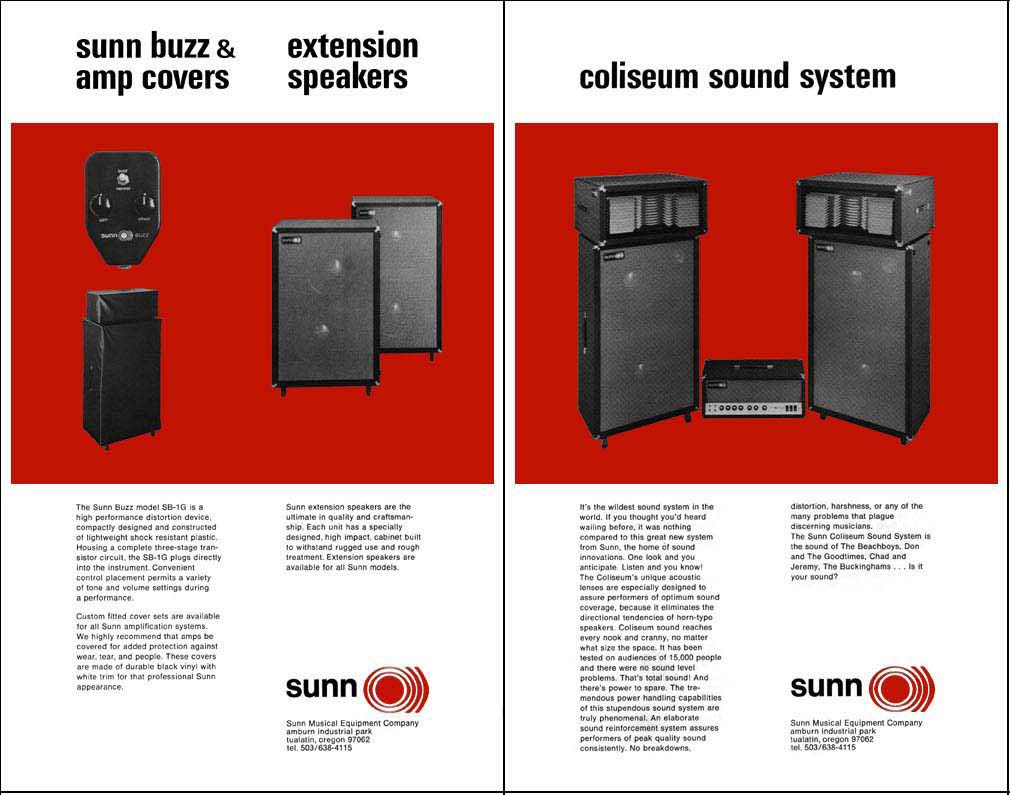
Later that year the Sunn Buzz got a little overhaul and became the unit we're discussing today; Which switched up some component values, the transistor type, and the look slightly. These new plugins were to be Sunn's big break into the effects world, with full brochure adverts showing off the little black beauty;

"The Sunn Buzz model SB-1G is a high performance distortion device, compactly designed and constructed of lightweight shock resistant plastic.
Housing a complete three-stage transistor circuit, the SB-1G plugs directly into the instrument. Convenient control placement permits a variety of tone and volume settings during a performance."

Although it is unknown exactly how long they made the Sunn o))) Buzz, we do know that it stopped popping up in catalogs around 1969. So with possibly only 3 years of production, and poor sales in what was becoming a heavily saturated market, it seemed like Sunn had bowed out of the effects business for good.

This was bad news for Sunn and its followers; but today all of this just adds to the lure and mystique surrounding this cool box.

So what are we waiting for! Let's talk about how this baby sounds:/:

Like was stated before, the Sunn Buzz takes its cues from the Maestro Fuzz Tone FZ-1a. It runs off of one AA battery, which is enough for an effect like this. The sound is pretty cool, but I will say though, before anything else, that there is one area the Sunn Buzz does lack in, and that's the bottom. There is just NO low end whatsoever! It was quite annoying at first, as I could tell there was a really cool fuzz-tone hiding somewhere in there. So I decided the best way to fix this was by simply running it through either an EQ or a booster pedal like the UMI Treble-Bass Booster. And once I got that right, it was on///


Although the Maestro is a good point of reference, the Sunn Buzz is quite a bit meaner sounding. The first characteristic that stood out from its predecessor was that the overall tone itself is more of a controlled chaos. Where the Maestro, and it's cousin the MKI Tonebender, sound like someone has plugged into an exploding atom, the Sunn Buzz has the typical FZ-1a splat and static but with a steady, thick underbelly. And when paired with a bass booster of some sort, this can go from raunchy 60's fuzz to a primitive all out DOOM machine of death!!! or something...

OK, so maybe it won't make you sound like a down-tuned master, but it is damn cool nonetheless!

The name "Buzz" does fit it pretty well, in my opinion. If you roll back the gain knob just a bit you can easily get what I would consider a buzzing, squarewave tone; which is cool for your Satisfaction covers at the bar.

Here is a nice audio demo recorded by our friend Charge from the D*A*M forum with this more buzzy setting on display:
Sunn Buzz Clip

Well, there's not really too much more to the Sunn Buzz so we will just leave it at that, for now.

I hope you all dug this newest review post, and remember to keep digging for those old boxes of gold!

goodbye///

thanks for reading!
-ed

Saturday, June 23, 2012

Mu-Tron Dan Armstrong Store Display!

☟ 
This just popped up on ebay and I thought it was too awesome not to re-post here///


Thanks for reading!
-ed

Monday, November 7, 2011

Goodrich String Box (1979)

☟
While I continue to seek obscure fuzzery I, at times, find myself down odd paths. A stranger in strange lands and internet forums, hoping to uncover something I have never seen before or heard of. I figure, since fuzz circuits are part of Electronics Engineering 101 at many colleges, and since it's the 1st thing a new pedal builder decides to create, there has to be a ton of weirdo fuzzness out in the world, waiting for me to uncover!

This vision quest has brought me to exciting lands of BUZZING! SHRIEKING! and even some, SLUDGING.
but to the here and now, at this moment...

I give you, the Goodrich String Box!


Ok, so maybe I hyped that up a bit too much, but it really is a nice sounding little fuzz tone.

I was first introduced to Goodrich Sound Co. while lurking through Pedal Steel forums looking for Jordan Boss Tones. I had read that the Boss Tone was THE fuzz for Steelers, so I thought they must have a bunch for sale somewhere? As it turned out, they did! I actually purchased a few of my Boss Tones, past and present, through some online pedal steel communities. But even more awesome than that was discovering an effect called the Goodrich Steel Driver II. This seemed to be one of the holy grail fuzz tones for the Steel community. So I figured I would track one down, and luckily I did, twice! (and we will discuss them in detail at a later date), but it got me to research this "Goodrich" and find out there were a few other cool fuzzes they put out. The original Steel Driver, the Fuzz Box and there is also a Steel Driver III that is currently in production.


One thing I noticed from checking out the Steel forums is that they refer to the sound of the Boss Tone as very "violin-like". So when the Goodrich String Box popped up for sale I figured it could only be one thing... a fuzz! So I went for it completely blind, as there was absolutely NO information at all about this effect anywhere on the web? The only reference I found was a post on the Steel Guitar Forum where a dude asks if anyone knows what it is...
He received 0 replies.

So I have been trying to figure out any sort of history on this thing, and the best I could do was realize it was made when Goodrich was located in Grand Haven, MI. Unfortunately I don't know when that was (if you do, please post a comment as I would really love to know!) but I do know that they were in Ruskin, FL before this, Whitehall, MI after this and later Dublin, GA. So I can only speculate that this is from the late 70's to early 80s.

Why? Well, why not!


I know; all of this gabbing and nothing about the sound yet!

So back to what we were saying earlier about the Boss Tone and it being THE fuzz for Steel players. It seemed as though a lot of other companies wanted to jump on the fuzzy bandwagon for their own, so a lot of early Boss Tone "clones" came out of the Pedal Steel community in the 70s and 80s, this being one of them.

In an earlier post we put up a video comparing three different versions of the Boss Tone. The last one in the vid was a Nashville, Music City version. This is the version that has most likely been cloned here, but with a couple changes. For one, there is no control for either Volume or Gain. The 2nd thing that is different is there is an added Tone control, that is actually kind of a crappy Low Pass filter. So as it stands, the String Box is set at Full Gain and Full Volume, these things you can adjust with your guitar's volume knob. I can only assume that this is the main reason Goodrich didn't make many of these, as it sounds pretty squishy and heavy; and in fact, it almost seems like a prototype (or maybe an after thought) as they most likely made them out of the same casings used for their extremely popular Match Box, and even packed it with the same paper work!


But back to the tone report././
The overall sound is really rich in harmonics, squelches and belches like some of your favorite 60s fuzzes and can get nice and crunchy with the best Muff. When I A/B'd it against my Nashville Boss Tone they were almost identical. They both have that fat low end and each note seemed to birth the next out of some swampy ooze. So basically, it sounds really cool. I also think it's kind of neat that it's supposed to clip onto a stand, so it's neither a pedal nor a plugin (but I'll categorize it as one for the sake of the blog).
So that is all for today.

Now, let's bring on the goods:


Sunday, October 30, 2011

Jordan Boss Boost (1967)

☟

Welcome to Part 2 of the Jordan Juniors series; featuring the sweet, scarce and subtly awesome Jordan Boss Boost!

In Part 1 we looked at the first version of the Boss Tone fuzz from 1967 and also went over some Jordan Electronics history. So today I will keep the background details to a minimum, and instead give you some TONE talk and pedal pics... But before we get in deep, let's just do a mini story of where this little punk came from.

OK, so again taking a cue from VOX, specifically the Treble/Bass Booster plugin (1965), Jordan decided to make a plugin effect that boosted both the guitar's Treble and Bass. Improving on the design ergonomically and functionally, Jordan made the box more compact than the VOX and it had separate controls for Treble and Bass. Although the pre-history and inspiration are pretty clear, the production history of this little guy is somewhat hazy. It does appear as though Jordan only produced the Boss Boost for one year, 1967. They continued to advertise the effect until 1969 when they moved factories from Alhambra, CA to Pasadena, CA.


Before I got really into effects pedals I never understood the idea of a "clean boost". I also didn't own a tube amp nor did I understand the whole "stacking effects" thing. But my first encounter with the awesomeness of Boost pedals was a clone someone made for me of a Dallas Rangemaster. Being a huge Black Sabbath fan and knowing that Tony Iommi got his signature tone from a Rangemaster going into a Laney Klipp amp, I had to try one.

When I got it in the mail I ripped open the package like it was Christmas morning. Overjoyed, I plugged into my new, cool pedal. And there it was... complete disappointment; I heard nothing! All I could hear was that my guitar's high end was louder and more crisp. So I started to experiment. First running it into some fuzz pedals, then switching the order, which was pretty awesome but still not what I was looking for. Then I finally decided to run it into some hot tubeage, and in a devine moment a bright light shined down from the heavens and angels began sing my name. I finally got it! It was that big volume boost of the high end into the tubes that created THE Sabbath tone I grew up loving, and there it was for me. Needless to say I dropped in a wah and played Electric Funeral for about 4 hours.


The Jordan Boss Boost is great for what it is. You can easily get that Rangemaster tone, but with the added Bass boost, you can bang a full body to your sound too. I really like how it can fill out even the most thin fuzz tones, and add some "vintage" character to newer pedals. The best combinations so far have been Big Muff > Boss Boost and MKI Tonebender > Boss Boost. As I mentioned before, the Boss Tone > Boss Boost combo is pretty cool too. So it may not be one of the most unique or distinct effects ever, but it's nice and warm and stacks amazingly with your other fuzzes.

Well that's that! The end of our Jordan Juniors post, until I get my Vico Vibe././ So thanks for hanging with us today.><. and now, I leave you with some pics:


Thanks for reading!
-ed