
Over the last five years the internet has provided me with endless avenues of dopamine-inducing research tools for learning about the history of guitar pedals. One of which is the invaluable category of website known as the “newspaper database”. They host hundreds of thousands of printed articles going back to the 1800s, and within them I’ve been able to find previously unknown release dates for certain pedals, names and faces of company owners, and even full articles on the initial reception of “Fuzz” as a wild! new! sound in the early 60s.
But one thread that seemed to weave its way through all of these discoveries was that for the most part, women appeared to be responsible for physically building much of the music gear we now covet as classic “vintage grails”.
I knew that I could not be the first person to have this revelation, so I kept searching. And while there were plenty of articles written about specific women who influenced tech, and music in general, I was really only able to find this one article that highlighted the integral role women played in taking electronic technology from the grasps of the elite and placing it into (almost) every American home by the 1950s.
And even though I wasn’t able to find much, and this has to have been written about 10,000 times already, I still feel like doing my own guitar pedal-nerd take on the subject. So here we go :)
What I learned from the ETHW article linked above, is that around the turn of the century it started to become commonplace to specifically hire women for factory assembly work. And with the proliferation of radio in the 1920s, these women shifted from things like mechanical watch assembly to more electronics-based manufacturing.
As the article states, this was something of a balance (although if we’re being real, it was probably much closer to an 80/20 split) between corporate exploitation, and feminine liberation. On one hand, the companies preferred to hire women because they could pay them significantly less than men for the same output. On the other hand; there is a certain level of freedom associated with getting out of the house and working, and of the equivalent jobs available to women in those days (sewing in sweatshop factories or manual labor), sitting down and soldering circuit boards all day was certainly preferred.
By the time the 1960s rolled around the idea of a factory filled with women working the production line was not only the standard, but every step of the process was designed to keep this machine in place.
Take the want-ads for instance:
Throughout the decade a “Help-Wanted” section divided by Male and Female could be found in the back of any local newspaper. The jobs for men were typically higher in rank/status; designers, salesman, foreman, etc. while the positions for women were relegated to the lower rungs of the workforce; secretaries, seamstresses, and of course electronic assembly workers.
The result of this was a specialized workforce dominated by women, who were responsible for building an extremely wide array of electronics. This would trickle down to nearly every piece of music gear one could purchase at the time. And when I say every piece of music gear, I quite literally mean everything from the transistors to the capacitors, to the footswitches, to the PCB’s.
The lone “boutique” builder phenomena was not yet in fashion, and those who did go into business fully by themselves were fighting a huge uphill battle against giants like Fender, Ampeg, and even smaller brands like Applied Audio (who built the Goya Panther Fuzz, amongst others). Nearly all of it was made in factories by a group of underpaid, but very skilled female engineers (you know what, yeah! they WERE engineers).
While I was able to find “female only” want-ads for nearly every well known electronics manufacturer in the 60s, two of them immediately stood out for playing a part in my favorite vintage fuzzes.
Fairchild Semiconductor was a leader in the production of transistors throughout the decade, and their parts can be found in everything from the Sam Ash Fuzzz Boxx to the Big Muff and countless others. But a company who’s components dominated early fuzz pedals was Massachusetts-based, Sprague Electric. I have seen their capacitors show up in pedals like the Manny’s Fuzz, the Maestro Fuzz Tone, and the ACA Fuzz King. But most famously, Sprague was responsible for the infamous circuit “blob” (precursor to the IC) found in Mosrite Fuzzrites from 1968-69, and later in the Nu-Fuzz by Rosac.
Speaking of; in an article from 1968 photographer Jack Knight took the reader on a factory tour of Mosrite of California. And in it, was this AMAZING photo above of technician Birdie Lewis hand-assembling Fuzzrites! This has to be one of my favorite images I have ever found in a newspaper database, and the main inspiration for this article.
The other example that was directly related to vintage pedals is below. Trans-Tek Mfg. was mostly known for buying old-stock bulk electronic components from various sources (including the military), and then repackaging and selling them to both manufacturers and direct to customers. Additionally, their factory in South Plainfield, NJ housed Applied Audio (mentioned above), who’s fuzz pedals were almost as ubiquitous throughout the late 1960s as Maestro’s.
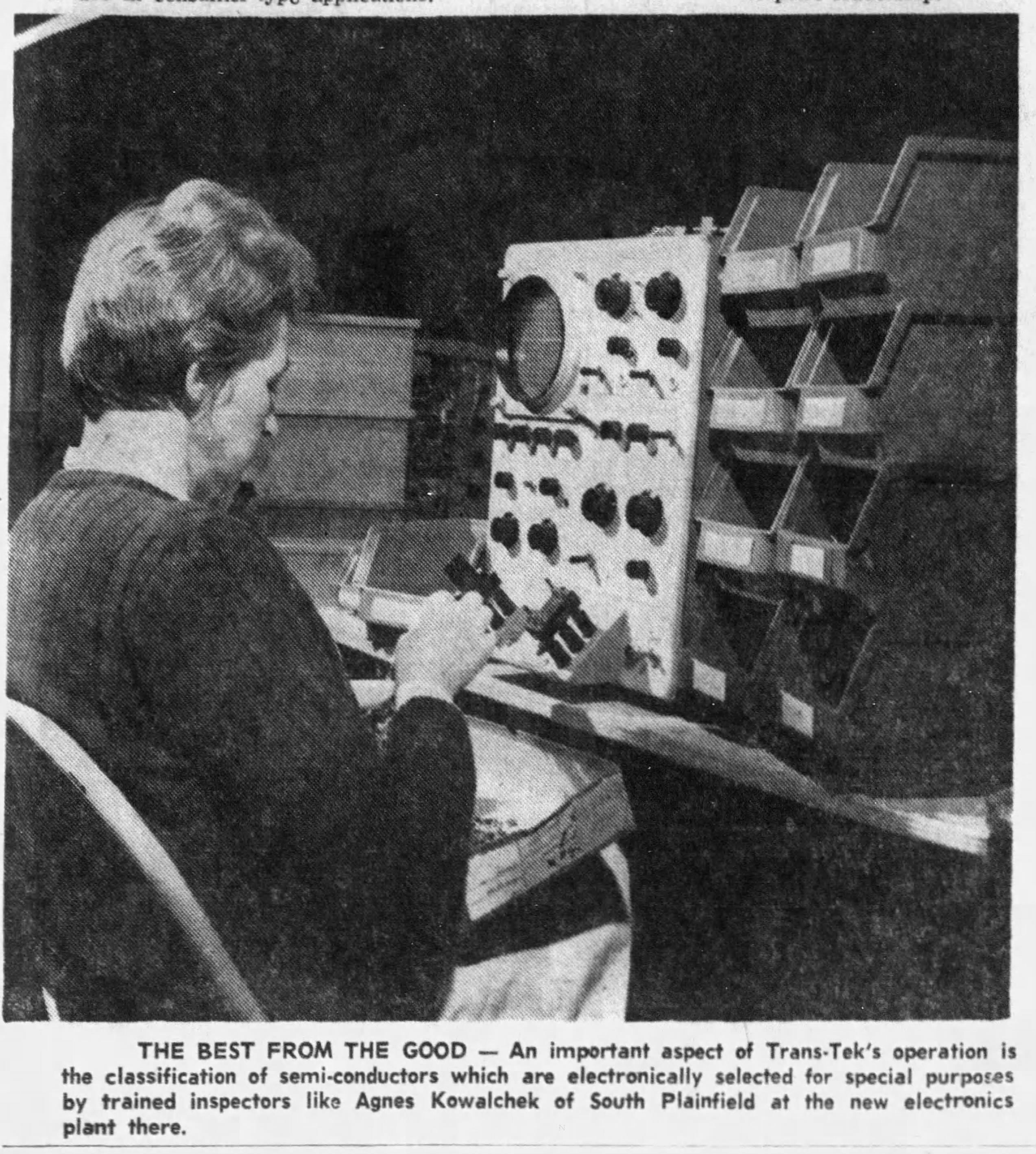
Applied Audio also employed a predominantly female staff who not only built guitar pedals and amplifiers, but also the wide variety of electronic gadgets that Trans-Tek offered (like DIY kits, home alarms, and hand-held radios). And workers like Agnes Kowalcheck had the important job of checking the quality and value of each individual component before it was put to use.
This practice, while born in the US, was not confined to it.
Below is a completely ridiculous, and somewhat famous (infamous?) image from Japan’s Sony factory in 1960; showing a line of female workers taking their hourly stretch break, while being overseen by a whistle-blowing manager.
Absurdity aside, I do think it’s important to shine a light on this overlooked/forgotten/unknown piece of Rock & Roll history. And for me personally, it was just a super cool epiphany I was having while digging through the past; and one I had never even considered…
“WHO was sitting down, day after day, actually soldering together all of these stompboxes that I love and have dedicated so much of my time?”
And when it started to become apparent that it was almost exclusively women, I was truly blown away. And mostly because I had never heard anyone tell this story before.
But one thread that seemed to weave its way through all of these discoveries was that for the most part, women appeared to be responsible for physically building much of the music gear we now covet as classic “vintage grails”.
 |
| Electro Harmonix factory workers assembling guitar pedals in 1978. credit: Rolling Stone |
I knew that I could not be the first person to have this revelation, so I kept searching. And while there were plenty of articles written about specific women who influenced tech, and music in general, I was really only able to find this one article that highlighted the integral role women played in taking electronic technology from the grasps of the elite and placing it into (almost) every American home by the 1950s.
And even though I wasn’t able to find much, and this has to have been written about 10,000 times already, I still feel like doing my own guitar pedal-nerd take on the subject. So here we go :)
 |
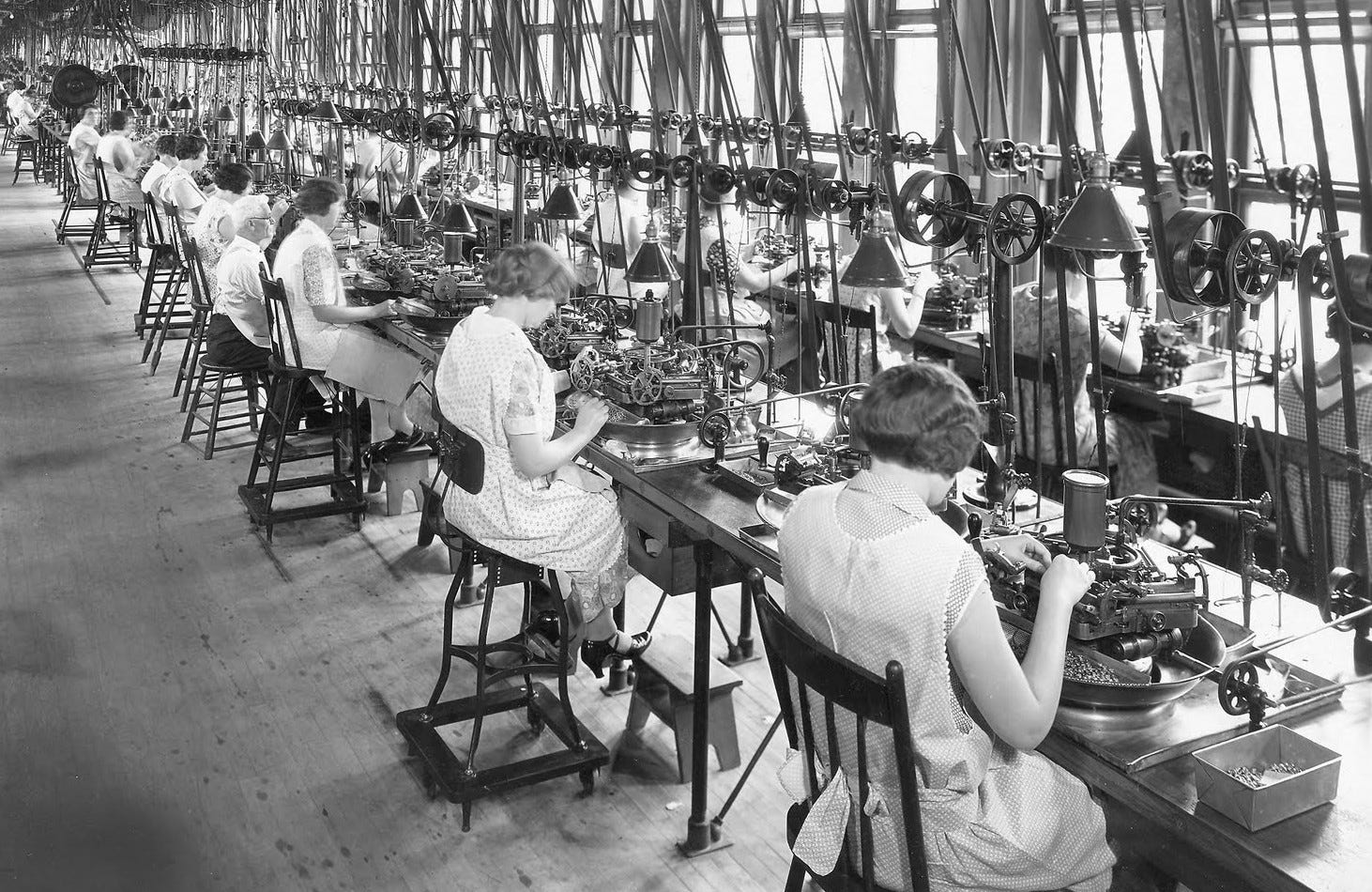
| Elgin Watch factory, 1930. credit: Elgintime |
What I learned from the ETHW article linked above, is that around the turn of the century it started to become commonplace to specifically hire women for factory assembly work. And with the proliferation of radio in the 1920s, these women shifted from things like mechanical watch assembly to more electronics-based manufacturing.
As the article states, this was something of a balance (although if we’re being real, it was probably much closer to an 80/20 split) between corporate exploitation, and feminine liberation. On one hand, the companies preferred to hire women because they could pay them significantly less than men for the same output. On the other hand; there is a certain level of freedom associated with getting out of the house and working, and of the equivalent jobs available to women in those days (sewing in sweatshop factories or manual labor), sitting down and soldering circuit boards all day was certainly preferred.
By the time the 1960s rolled around the idea of a factory filled with women working the production line was not only the standard, but every step of the process was designed to keep this machine in place.
Take the want-ads for instance:
 |
| credit: The Daily Breeze |
Throughout the decade a “Help-Wanted” section divided by Male and Female could be found in the back of any local newspaper. The jobs for men were typically higher in rank/status; designers, salesman, foreman, etc. while the positions for women were relegated to the lower rungs of the workforce; secretaries, seamstresses, and of course electronic assembly workers.
The result of this was a specialized workforce dominated by women, who were responsible for building an extremely wide array of electronics. This would trickle down to nearly every piece of music gear one could purchase at the time. And when I say every piece of music gear, I quite literally mean everything from the transistors to the capacitors, to the footswitches, to the PCB’s.
The lone “boutique” builder phenomena was not yet in fashion, and those who did go into business fully by themselves were fighting a huge uphill battle against giants like Fender, Ampeg, and even smaller brands like Applied Audio (who built the Goya Panther Fuzz, amongst others). Nearly all of it was made in factories by a group of underpaid, but very skilled female engineers (you know what, yeah! they WERE engineers).
 |
| Fairchild Semiconductor assembly line, 1960, credit: Marin Independent Journal |
 |
| Sprague Electric factory workers test components, credit: MASS MoCA |
While I was able to find “female only” want-ads for nearly every well known electronics manufacturer in the 60s, two of them immediately stood out for playing a part in my favorite vintage fuzzes.
Fairchild Semiconductor was a leader in the production of transistors throughout the decade, and their parts can be found in everything from the Sam Ash Fuzzz Boxx to the Big Muff and countless others. But a company who’s components dominated early fuzz pedals was Massachusetts-based, Sprague Electric. I have seen their capacitors show up in pedals like the Manny’s Fuzz, the Maestro Fuzz Tone, and the ACA Fuzz King. But most famously, Sprague was responsible for the infamous circuit “blob” (precursor to the IC) found in Mosrite Fuzzrites from 1968-69, and later in the Nu-Fuzz by Rosac.
 |
| The original caption is already perfect, 1968, credit: Bakersfield Californian |
Speaking of; in an article from 1968 photographer Jack Knight took the reader on a factory tour of Mosrite of California. And in it, was this AMAZING photo above of technician Birdie Lewis hand-assembling Fuzzrites! This has to be one of my favorite images I have ever found in a newspaper database, and the main inspiration for this article.
The other example that was directly related to vintage pedals is below. Trans-Tek Mfg. was mostly known for buying old-stock bulk electronic components from various sources (including the military), and then repackaging and selling them to both manufacturers and direct to customers. Additionally, their factory in South Plainfield, NJ housed Applied Audio (mentioned above), who’s fuzz pedals were almost as ubiquitous throughout the late 1960s as Maestro’s.
Applied Audio also employed a predominantly female staff who not only built guitar pedals and amplifiers, but also the wide variety of electronic gadgets that Trans-Tek offered (like DIY kits, home alarms, and hand-held radios). And workers like Agnes Kowalcheck had the important job of checking the quality and value of each individual component before it was put to use.
.jpg) |
| credit: The Central New Jersey Home News |
 |
| Those hourly rates seem insanely low… credit: The Central New Jersey Home News |
This practice, while born in the US, was not confined to it.
Below is a completely ridiculous, and somewhat famous (infamous?) image from Japan’s Sony factory in 1960; showing a line of female workers taking their hourly stretch break, while being overseen by a whistle-blowing manager.
 |
| credit: Associated Press |
Absurdity aside, I do think it’s important to shine a light on this overlooked/forgotten/unknown piece of Rock & Roll history. And for me personally, it was just a super cool epiphany I was having while digging through the past; and one I had never even considered…
“WHO was sitting down, day after day, actually soldering together all of these stompboxes that I love and have dedicated so much of my time?”
And when it started to become apparent that it was almost exclusively women, I was truly blown away. And mostly because I had never heard anyone tell this story before.
(quick, someone hit up Ken Burns!)
By the mid 1970s many of these manufacturing companies were moving toward a hiring preference for immigrants and people of color, who’s own struggle against prejudice and discrimination forced them to take whatever jobs they could, and as a result, whatever pay was offered. This move severely undercut the already insultingly low rate women had been getting, and ultimately led to their mass exodus out of the factories and into the same types of jobs men had been afforded for decades. And by the 1990s the majority of these electronic assembly jobs would be gone; sent overseas, where the exploitation of foreign workers still pervades today.
So while the irony of sitting here writing on my laptop, that was almost certainly made somewhere in Asia for pennies, is not lost on me. I truly do wish that those millions of workers also get their due-credit (and a living wage) some day in the near future.
But for now, I hope at least some of you have gained a new appreciation for the thousands of women; our grandmas, aunts, and mothers, who in the 1960s and 70s constructed everything from amplifiers to microphones to fuzz pedals; the same gear that helped create the guitar tone on your favorite album, the mind-altering synth odyssey on your favorite track, and the unforgettable sonic explosion you experienced at your all-time favorite concert. These forgotten women deserve our recognition and their long-overdo flowers, for quite literally, building Rock & Roll.
thanks for reading,
-ed
----------------------------------------------
By the mid 1970s many of these manufacturing companies were moving toward a hiring preference for immigrants and people of color, who’s own struggle against prejudice and discrimination forced them to take whatever jobs they could, and as a result, whatever pay was offered. This move severely undercut the already insultingly low rate women had been getting, and ultimately led to their mass exodus out of the factories and into the same types of jobs men had been afforded for decades. And by the 1990s the majority of these electronic assembly jobs would be gone; sent overseas, where the exploitation of foreign workers still pervades today.
So while the irony of sitting here writing on my laptop, that was almost certainly made somewhere in Asia for pennies, is not lost on me. I truly do wish that those millions of workers also get their due-credit (and a living wage) some day in the near future.
 |
| Dolores Hacker assembling amplifiers at the Sunn Musical Equipment Co. factory, 1967. credit: The Oregon Daily Journal |
But for now, I hope at least some of you have gained a new appreciation for the thousands of women; our grandmas, aunts, and mothers, who in the 1960s and 70s constructed everything from amplifiers to microphones to fuzz pedals; the same gear that helped create the guitar tone on your favorite album, the mind-altering synth odyssey on your favorite track, and the unforgettable sonic explosion you experienced at your all-time favorite concert. These forgotten women deserve our recognition and their long-overdo flowers, for quite literally, building Rock & Roll.
thanks for reading,
-ed

No comments:
Post a Comment