☟
Zombie Fresh Eaters...
It's 1973 in Berkeley, California and a young electrical engineering wizard named Craig Anderton has just designed one of the earliest examples of an envelope filter pedal. He calls it the "
Funk Machine", and together with John Lang, starts an innovative and experimental guitar effects brand, Seamoon Inc. Hand-building each individual unit, they launch their new brand with that single pedal and quickly word starts to spread.
Fast forward a few months; Anderton decides it's time to expand, and with that he develops Seamoon's own version of the now classic fuzz effect, with a twist...
Over the years the
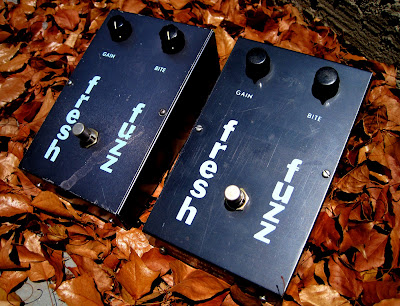
Seamoon Fresh Fuzz has been discussed, debated and dissected by every pedal nerd on the internet, but it's never been fully understood because so few people have actually held one in their hands. It's legendary status comes not just from its rarity, or its origin, but also from the fact that it was a favorite of Boston's Tom Scholz and has been used extensively by Eric Johnson.
Somewhere at sometime someone wrote a review about the Fresh Fuzz stating (incorrectly) that it was "thin sounding", and as rumors tend to go that misrepresentation has been repeated so many times that, to this day, virtually anyone you meet who has heard of (but not actually heard with their ears) the Fresh Fuzz will automatically say, "Yeah, aren't those pretty rare? I heard they're real thin sounding though."
Which brings me here, to my own personal mission;
Clear the good name of this legendary and groundbreaking stompbox once and for all, and lay to rest this distortion of the truth, bringing to light the real legend of the Seamoon Fresh Fuzz!
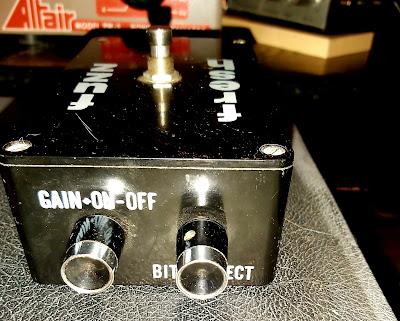
Originally built in a plastic Bakelite project box, the Fresh Fuzz was one of the first distortion units to substitute an operational amplifier (op-amp) for the typical transistor-driven fuzz. This allowed for a massive volume boost that no other pedal had at the time. Excited guitar players quickly snatched them up, but were unfortunately met with a crushing realization when they actually stomped on one, as the delicate pedal would shatter into a million pieces! Anderton quickly abandoned the plastic box and switched over to the slanted metal casing we all know today, keeping the circuit untouched. These original units had a sound that was closer to a classic low gain distortion with a nice breakup (think ProCo Rat with less gain) than a buzzing fuzz. With a big beefy low end, and a smooth amp-like crunch, the V1 Fresh Fuzz really changed the game. But as new innovations tend to confuse the masses, people didn't get it. And after just a few months in production, Anderton went to work on a redesign.
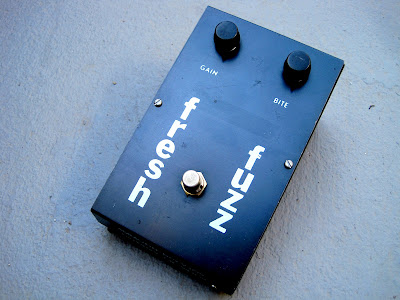
The V2 Fresh Fuzz rolled out at the beginning of 1974 and employed a dual 4558 op-amp, thus doubling the power of the 741 chip used in the original. This created an even larger gain in volume and some real deal fuzzzzzz. Most people prefer the sound of this version for it's versatility and overall tone. And this sucker was LOUD, and gritty and everything you could want from a pedal. On the spectrum of available fuzzes at the time (Maestro Fuzz Tone on one end, Electro Harmonix Big Muff on the other) the Fresh Fuzz would definitely lie closer to the Muff side, but it did have some of the great characteristics of those earlier boxes too.
It is unknown just how long they were made, but by 1975 the look and feel of Seamoon started to change, and less than year later Craig Anderton left the company. So the best guess is that the Fresh Fuzz was around for approximately 2 full years, with the V2 being in production for most of that time. It is hard to say just how many are out there, because this unicorn of a fuzz pedal is just so damn cool that people tend to hoard them! My personal quest took more than 8 years before finally finding both versions within three months of each other. I have only seen 2 of those original plastic Bakelite box units, 4 of the V1's, and maybe twenty to thirty V2's. So they are out there, but I like I said, I just have a feeling that not many people are ready to give theirs up.
I hope this will finally lay to rest the "thin sounding" fallacy that has been unjustly laid upon the Fresh Fuzz. In fact, there is a great demo online of 741 op-amp version that shows just how big, tough, ratty, and gnarly they can get (We posted it
HERE a while back). So let's come together and bring to light this wonderful relic of fuzzdom, and repeat after me:
"The Seamoon Fresh Fuzz, yeah I hear they sound like a an ancient monster rising from the depths of HELL!!!"
V1 circuit:

V2 circuit:

(*I originally wrote this article for Gearphoria magazine which appeared in July of 2015)
thanks for reading!
-ed


8cGJQjw~~60_57.JPG)