Wednesday, October 19, 2022

Deeper Phazzing

One of the reasons I love doing this blog is because every once in a while I am contacted by someone who has read an article and can give us some awesome additional info we previously didn't have... 


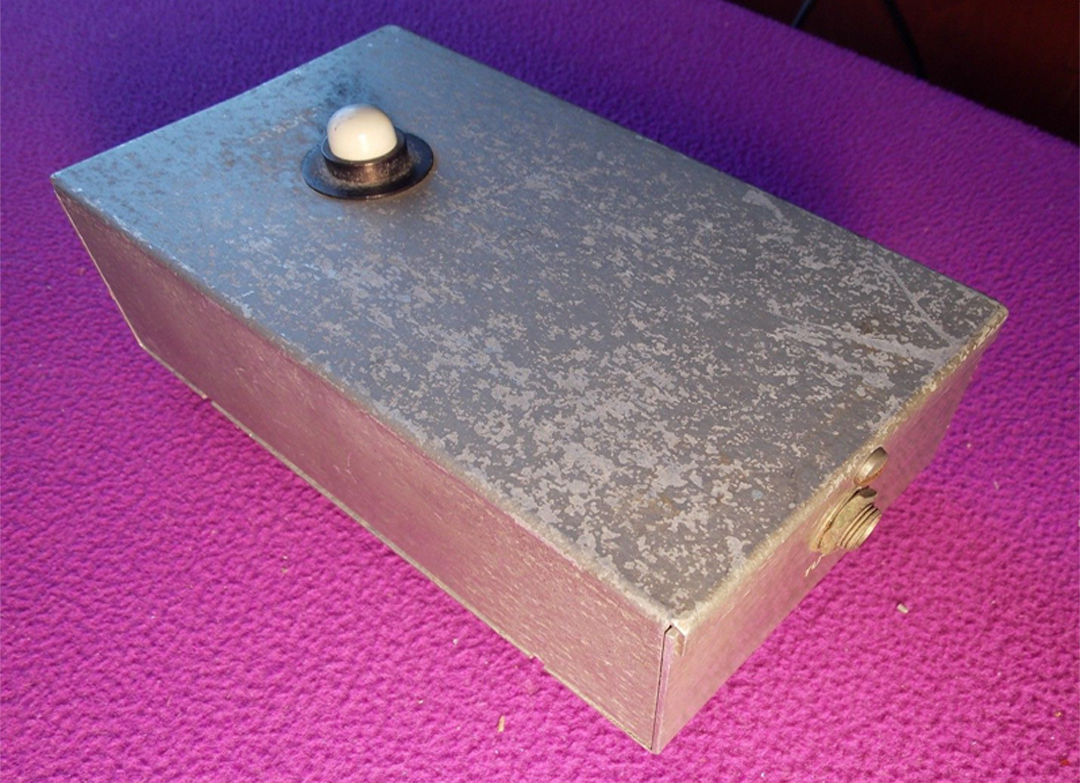
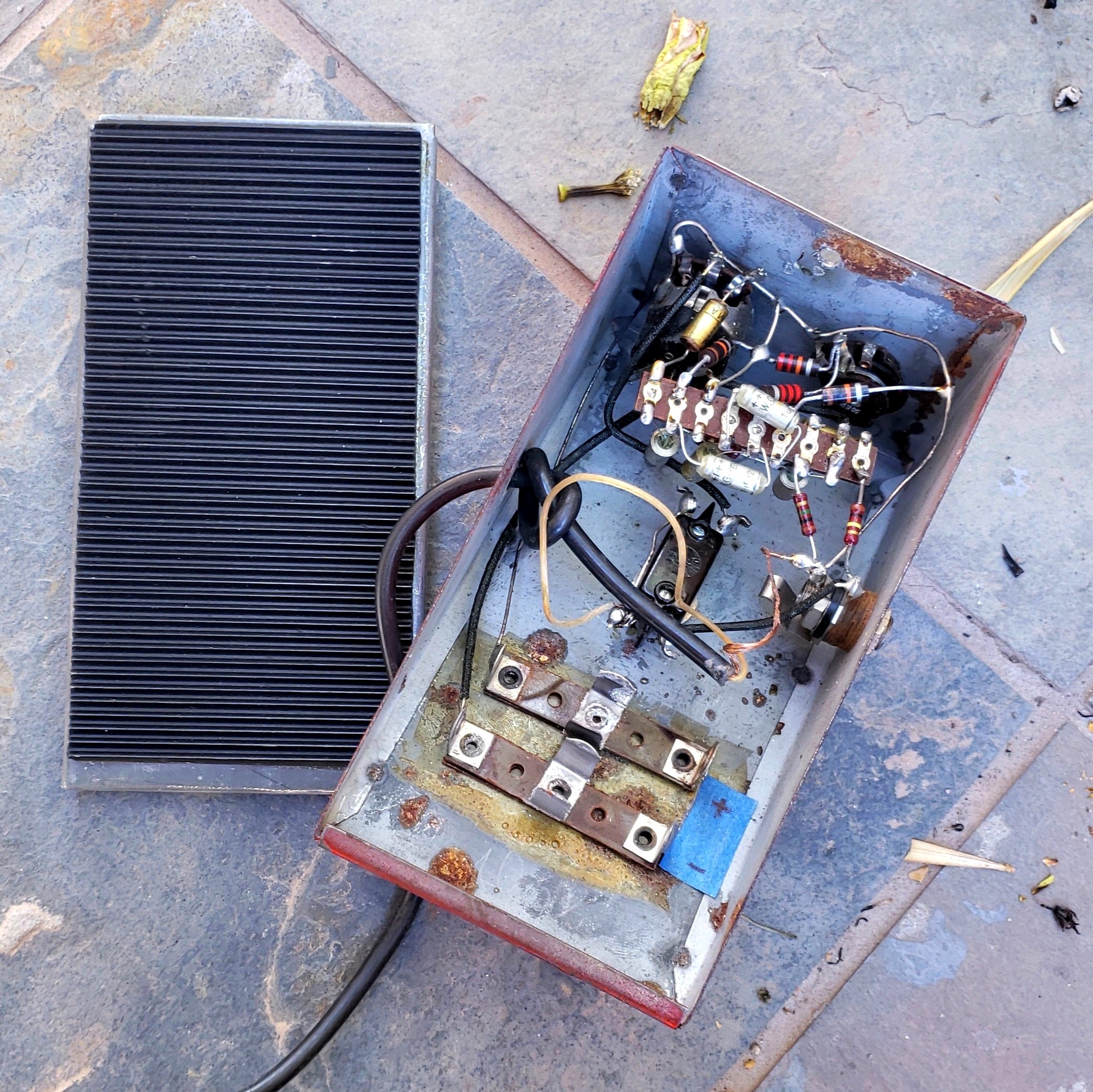
Way back in 2011 we featured an article on the mid '70s Ampeg Phazzer (read it here), and after a few years of being part of the online ether it caught the attention of the original designer, Donald Tillman! 

He was kind enough to add some really cool insider details on the pedal, so I'll just let you read them for yourself below:

Hi. I just discovered your excellent review of the Ampeg Phazzer. Thanks! I designed the Ampeg Phazzer. So if you have any questions about it, feel free to ask. 

This was manufactured by a company called "I W Turner", a very small music electronics company in the town I grew up in, Port Washington, New York. (That's on Long Island, just outside New York City.) This was a basement operation; literally, it was in the basement of a fabric store. It was a side project of the the local high school band director who had an inventor/entrepreneur streak. I was a nerdy kid, and I showed him some of my electronics work and he hired me part time to do some engineering there. The name is made up; the initials stand for the first names of the two partners, the Turner part was a family name that went well with it. The company sold music electronics to schools. The first product was a metronome. And since synthesizers and electronic music was getting popular then, we made a set of modules to introduce elementary school kids to the rudiments of electronic music; oscillators, filters, etc. 

At that time the phase shifter was the cool new guitar effect. (It changes the tone, but not in an obvious way.) We used an MXR Phase 90 as a model, and I reverse engineered it, and tweaked and improved the design a bit: 
 * replaced the individual FET's with a CD4069 chip, biased off so the internal FET transistors are available, it's cheaper and the FETs are matched 
 * better LFO circuit, the slow sweeps are smoother 
 * better mixing of the phased and original signals, better output drive 

At the time, Ampeg wanted to get into the stomp box business, so we made a deal to build some number of units for them. (My memory is telling me it was 1000 units, but I'm not sure that's right.) And these were branded for Ampeg (clearly). Ampeg later decided not to get into the stomp box business, and seems to have found them in a warehouse and sold them off at some point. 

"Time Labs" was a brand name of I W Turner, used on some of the products. 

There's no relationship to the Ampeg Scrambler Fuzz. Or any other Ampeg product for that matter. :-) 

And that line about the Univibe as inspiration; nope, 'never played or seen one. The Univibe is actually closer to the Magnatone. 

-- Don


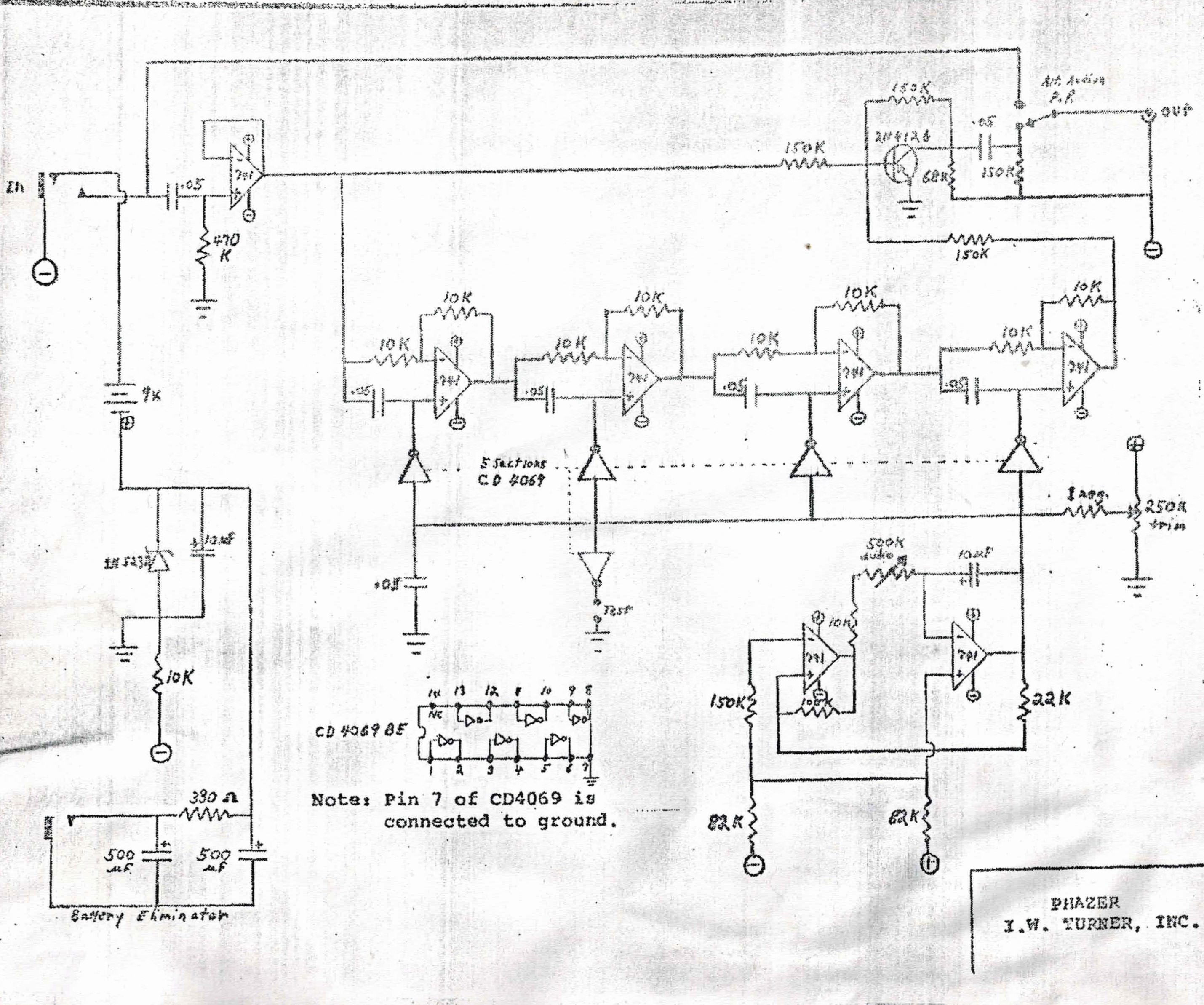
On top of that, I more recently stumbled onto an old post over at freestompboxes where the original manual for the Ampeg Phazzer was posted (thanks Jimi!). It confirms everything Don had to say in his email, in regards to the manufacturer, and helps solidify a more accurate story for this small piece of phase shifting (and Ampeg) history.



 Thanks for reading! 
 -ed

Friday, September 30, 2022

Knight Fuzz Box KG-389 (1967)


The mid-1960’s saw a glut of new Fuzz pedals entering the scene as the popularity of the Maestro Fuzz Tone soared. Riding this fuzzy wave, it seemed like every electronics-adjacent company was getting into the game. Some of these pedals became future classics (Sola Sound Tone Bender, Jordan Boss Tone, Univox Super Fuzz) while others were destined for obscurity (Sunn Buzz, GM Electronics Fuzz Up, Lectrolab Fuzz Buzz)...

The Knight KG-389 Fuzz Box was part of an interesting subset of this trend, the build-it-yourself kit. It was sold exclusively by Allied Radio of Chicago through their mail-order catalogs from 1967 through 1972. Knight Electronics Inc. was a subsidiary brand of Allied Radio specializing in DIY kits ranging from ham radios to tube amplifiers to synthesizers. Ordering an unbuilt kit, originally retailing for $12.95, was the only way to get your hands on the KG-389 Fuzz Box, and you had to literally solder it together component by component, guided by the detailed instructions. 


While it does sound cool as hell, one of my favorite things about this pedal is actually the borderline-ridiculous advertising slogans like, “Turn on this electronic fuzz box, and your audience too, for the wildest sound they ever heard." and “Turn on your guitar to freak out your audiences!” The copywriters at Allied Radio were clearly doing their best to capture the attention of  all the new hip young guitar freaks and geeks emerging from the 60s rock scene.


The Knight Fuzz, most interestingly, seems to be of its own design; which for a little $12 kit out of 1960’s Midwest, that’s saying a lot! Many of the fuzzes from that era were clearly Maestro rip-offs, and although the Knight is most similar in build to the Astro Amp Astrotone (1967), the two sound nothing alike. So what about it, how does this little blue wedged beastie sound?

While there are no known famous, or even obscure, recordings available of the Knight in action, there are a few decent video demos online (see this one I posted a while back). And in addition to that I also happen to have a unit right here that I can do my best to describe in ridiculous sonic detail! 


Comparing it to effects you may have heard before, the Knight Fuzz Box sits somewhere between a lower gain Mosrite Fuzzrite and a more precise Jordan Boss Tone (Alhambra, V2). 

It only has two controls, “Volume” and “Fuzz Tone”. The Fuzz Tone knob acts as the gain control, going from a nice round low-gain distortion all the way up to a squelchy splattery fuzz. It's also fairly sensitive, making it pretty useful at any setting. My favorite thing about the Knight Fuzz is that it retains a nice articulate bottom-end without ever getting too muddy; this was something its sonic sister the Jordan Boss Tone never got quite right. Another helpful feature is that it’s very responsive to guitar Tone and Volume adjustments, allowing for even more versatility and customization. One little trick I accidentally came across was using an old 9v battery that was on its way out; the result was a low rumbling, gated square wave fuzz perfect for bass!  

So while the Knight KG-389 Fuzz Box was never meant to be more than a cool low cost project kit for aspiring musicians/electricians, over 50 years later through a combination of rarity, simplicity and individuality it stands firmly on its own among the masses of overproduced 60s wedge fuzzes.  And maybe after reading this, you'll track one down for yourself and join the cool kids at the Knight club. 😎


Thanks for reading!
-ed
Monday, September 19, 2022

Things I didn't know existed... Davoli Trem Dix

One of these cool late 60s Italian pedals just popped up for sale, and the nerd in me freaks out any time I see something I never have before! I did some digging and came across not only some good photos (thanks freestompboxes) but also this youtube demo of the rare Davoli Trem Dix! It's not the best sounding recording, but I think you can get the idea at least...😁


Thanks for reading!
-ed

Wednesday, September 14, 2022

Jennings Fuzz (original packaging for the nerds)

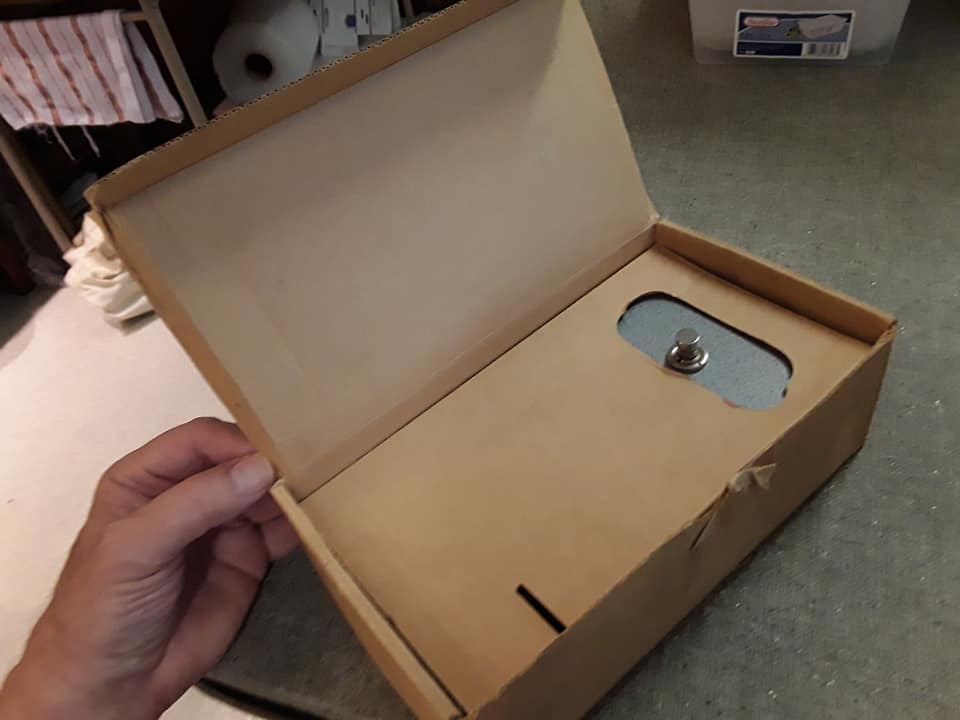
A few weeks back I was scrolling through one of those Facebook vintage pedal groups and came across a post from member David W. who put up these photos of his late 60's Jennings Fuzz, complete with the original box and paperwork! To give you an idea with how rare this is, I've been collecting pedals for over 20 years and this is only the second one I've seen with its original box... 

But beyond the rarity, the most interesting thing is the attention to detail they put into the box design itself, with that little cutout for the switch! It's nerdy as hell, but I find that such a cool little addition. So a big thanks to David for letting me share his photos here; and hopefully you can appreciate how awesome this is. 🙏


For more info on the Jennings pedals, definitely hit up the Fuzzboxes.org article here.

thanks for reading!
-ed

Friday, August 19, 2022

D-B Industries / D&M Co. (Another Fuzz Mystery)...

A lot of what we do here at Tone Machines is dive headfirst into the nerdiest kind of speculation about the unknown details of otherwise unknown pedals. So get ready...

Over the last month I have been happily losing my mind digging through old photos (that go way back to 2002) of all the weird, unique, and super rare pedals I have come across on the net. This past week I made an interesting discovery when I realized that the rare D&M Co. Distorto clearly has a sister pedal, made by a company with a similar name, in the same town, and roughly at the same time; the D-B Industries Supertone!


When the Distorto came up for auction back in 2015, while I'm still pretty bummed I missed out on it, I was very pleased that it wound up in the hands of fellow pedal collector, Simon Murphy of Good Fuzzy Sounds. Which means we got some insight to it's character; he described it as, "a lot like the FZ-1... louder and slightly bassier". It's circuit is thought to be based on the Maestro FZ-1, it was probably built around 1966, and Simon even found a potential connection to the best Steppenwolf song:


Here's the text from a web chat in 2006 with guitarist Michael Monarch:

"Hey Michael, What type of fuzz box did you use on the song called "The Pusher" from the first album?" 

"Hello Robert... I had an old prototype distortion box called "Distorto" which I may have used. It was a silver homemade looking box with a big red footswitch button and the word Distorto on it. I don't know where I got it or what happened to it."

So that's super cool, and almost certainly is referencing the same "Distorto" we are discussing here. But what about the mysterious "D-B Industries Supertone", which I can't find any information on at all. anywhere. in the entirety of the internet. And the only real evidence that it even existed are these four photos I've had since the early 2000s...

The minute you start comparing these two you begin to notice the obvious similarities; the enclosure for both is a classic folded metal project box, the circuits may have different components but otherwise look pretty damn close, and the biggest similarity has to be those manufacturer stamps on the bottom plates (which while they are different fonts, follow the same pattern of company name-city-model name-serial number, all within a rectangle), oh and both were manufactured in Santa Ana, CA!

So have a look and see what you think. And please leave a comment if anything jumps out at you that could possibly tie these two together (or completely destroy my theory) even more!


Quick little Distorto Demo:

Unfortunately I don't know where the D-B Supertone now resides so there's no additional info (yet!). But I am hoping that maybe an old magazine ad pops up, or even better, another unit!

So if you happen to know any additional info about either of these please shoot me an email or message me on instagram. I would love to crack the case on this one.

And a big thanks goes out to Simon for the all the details and the video demo of the Distorto (go check out Good Fuzzy Sounds now!), and thank you for reading.

-ed

Monday, August 15, 2022

FUZZY Pep Demo

Sometimes it can be almost impossible to find legit demos of pedals that fall into that "ultra rare" category, but lucky for us our good friend Rafmax has posted some of his insane collection over on his youtube channel

The one we're going to check out today is an awesome comparison video that features the unbelievably rare FUZZY vs. the WEM Rush Pep Box vs. the Maestro FZ-1 vs. the Maestro FZ-1A

Check it out:

Not sure how you all feel about that video, but after personally owning all of those pedals myself, I feel like the FUZZY sounds far and away better than both Maestro fuzzes; and it's so different from the WEM that it's hard to make a real comparison between the two. 

A couple of years ago I lucked myself into a FUZZY, that inevitably kicked open an entirely new door of speculation about the history and origin of this pedal... Is it German? Who designed it really? How many are actually out there??? 


So as always, if you happen to be a fellow owner of another FUZZY (with Pep) Fuzz, please shoot me a message either through email or instagram.

thanks for reading!

-ed