Sunday, February 9, 2025

Pro Suzzzz Fuzzzz: What? Who?

☟
I can't remember exactly when or where I heard about the Pro Suzzzz Fuzzzz for the first time, but I do remember being simultaneously perplexed and completely confident that I knew what was inside. A very quick glance will obviously bring up mental images of the Mosrite Fuzzrite, as the Pro Suzzzz is clearly built inside one of those legendary enclosures. So my first instinct was to assume that it was nothing more than a Fuzzrite with a tone control added. But over the years more pictures surfaced, and with them, more questions left to be answered.

So where did the Pro Suzzzz Fuzzzz come from, and who was responsible? At some point, some one definitely made this pedal. And while it really kind of seems like a very specific (famous) builder, there is enough here to make us question everything we think we know...

Pro Suzzzz Fuzzzz


If the name "Ed Sanner" came to mind, you're not alone. Sanner, after creating the original Fuzzrite, went on to design for Rosac Electronics and made pedals like the Nu-Fuzz and Distortion Blender. These effects expanded on his earlier creation, with many featuring his signature eyelet-board construction that was seen in the pre-Sprague era of the Fuzzrite.

If we look at the Rosac Distortion Blender below and compare it to the Pro Suzzzz Fuzzzz underneath, it could definitely lead you to believe that they were at least possibly built by the same person.

Pro Suzzzz Fuzzzz


Pro Suzzzz Fuzzzz

But to play devil's advocate; just because they share a similar build style, same resistors, same gold capacitor, and possibly the same black silicon transistors, does not necessarily mean they were built by the same person.

When we look at 60s Japanese fuzzes, most of them share an almost identical construction. Which has lead many to believe that a single company was responsible for almost every pedal produced in Japan from 1968-1972. But when we dig a bit more, we find out that almost all of the Japanese builders were getting their parts from a single shop. Additionally, most of them were straight up copying each other's looks and designs. 

So while it is probable that these two pedals share the same origin, we will have to go a little deeper to be sure.

Pro Suzzzz Fuzzzz

The next interesting piece of the puzzle is this, the Iron Butterfly Fuzz Wa. Another project spearheaded by Ed Sanner that sadly never really came to fruition. There were enough made that you will see one come up for sale at least once every other year, but they are fairly rare.

The original reason I even thought about this was the spelling of the word "Fuzzzz". Oddly enough the Iron Butterfly uses four "Z's", just like you'll find on the Pro Suzzzz Fuzzzz.

Additionally, and again like the Pro Suzzzz, the circuit itself does not seem to be based on the Fuzzrite. And the construction is done using an eyelet board, shares the same resistors, and those green caps.

Pro Suzzzz Fuzzzz

But... let's see what else we can find.

So about a year ago I came across this weird Fuzz-Wah. From the outside it looked like it was going to be another Guild/Applied FW-3. But upon seeing the inside, it was something completely different.

That build style, those parts; where have I seen them before! It kind of really looks like a combination of everything we've seen so far and the early version of the Rosac Nu-Wa Fuzz.

Pro-Fuzz


Pro-Fuzz

Can you name all the similarities jumping out at you right now?

Well one that you may have missed, is the "Fuzz" logo itself. Look back at the photo of the Pro Suzzzz Fuzzzz and you will notice that the font is identical.

And while I sit here typing this, staring at a screen filled with pedals, I am hit with a memory; the image of a 2 knob Pro Suzzzz that I had possibly seen years ago. So I went digging (and digging) until I found it! And as I suspected, even more similarities poured into my lap.

The "Fuzz" logos are literally the same. And while it's hard to tell, when you zoom in, it appears as though they both use the same transistors.

Another thing I realized about the Pro-Fuzz, which is almost certainly just a coincidence, is that it vaguely looks like the AUL Foxey Lady inside. Again, probably unrelated, but I figured it was worth a mention. 

Pro-Fuzz


Pro-Fuzz

Pro-Fuzz

Lastly, when compared to the Rosac fuzz, while it's not the same layout, it is super similar in build style. And both are (probably) Fuzzrite derivatives.

This feels like a bit of a stretch, but "Pro-Fuzz" and "Nu-Fuzz" might not be a coincidence either... 

So what is going on here?

If anything, it seems very likely that the Pro Suzzzz Fuzzzz, the Pro-Fuzz, and the mystery Fuzz-Wah were all made by the same person. 

Pro Suzzzz Fuzzzz

But was it Ed Sanner?

My best answer is that it really "feels" like it is. There are almost too many similarities to be a coincidence. But then again, if he had a completely different pedal company then why has he never talked about it before? Sanner has done multiple interviews in the past, and always went into the story of Mosrite, Rosac, his Sanner amp brand, his 90s Fuzzrite reissue, and his more recent Hallmark Nu-Fuzzes. But has never once mentioned the "Pro-Fuzz".

Is it possible that someone else associated with Mosrite, maybe someone who worked there soldering pedals all day, started his own company? We know they sold off deadstock Fuzzrite enclosures (*see the ZB Custom Fuzz) and there was that crazy "Electro Harmonix" Fuzzrite discussed on Totally Normal Behavior a couple years back. We also know that Mosrite did have a factory, and it wasn't just Sanner sitting at the bench all day soldering thousands of pedals by himself. So is it possible this wasn't him at all? 

Yes.

Just highly unlikely. 😁

So what do you think? Do you have any more photos or info that could help solve this fuzzy mystery? Do you know anyone who was directly involved in Mosrite or Rosac and could ask them??? If so, to any of those, please send me a message via Email or Instagram.

thanks as always for reading,
-ed

Friday, February 7, 2025

Made. In. Japan. Fuzz.

☟
Awesome new video from Mike & Mike's Guitar Bar featuring some of the best vintage Japanese Fuzzes ever made!

Check it out here//


thanks for watching,
-ed

Thursday, February 6, 2025

Earliest Jordan Boss Tone Advertisement?

☟

All the way back in 2011 I wrote this article on the history of the legendary Jordan Boss Tone fuzz. At the time it was my belief that the official release date landed somewhere in 1967, despite reports of a potential "prototype" version (*see image below) that was shown at either the 1966 NAMM show or in one of the large volume distribution catalogs like Targ & Dinner or David Wexler & Co, of the same year. *sadly the origin of the above photo is still unknown

At this point, and to my knowledge, a Boss Tone with this logo has never surfaced. And to the keen observer, you may notice that it shares a very similar graphic style to the insanely rare Jordan Vico Vibe. Which leads me to the believe that it wasn't a prototype at all, but simply the earliest version Jordan produced.


If this is the case, and 1966 is the true beginning of the Boss Tone, then it would answer the one question I've always had... Which was; if the Boss Tone came out in 1967, then that would leave an extremely short period of time for them to go through 4 different circuit variations!? 

By the Summer of 1968 Jordan Electronics moved from Alhambra to Pasadena, CA. and had already created the final, and most popular version of the circuit. But to get there they to go through a lot of fine-tuning and redesign. So with even just one additional year of production under their belts, this story begins to make a bit more logical sense.

Well that brings us to this awesome piece of evidence I found just a few weeks back; which is a newspaper ad from October of 1966. It was in the pages of the Eureka Humboldt Standard, out of Eureka, CA, and placed by Peets Music Co. who was apparently the exclusive dealer for Jordan Amplifiers in that area. We sadly don't get much in the way of a photo or description of the Boss Tone, but it's cool to see that it was promoted as a "Fuzz Tone' and originally sold for $29.95.


With this revelation, I may have to go back and edit my original Boss Tone post, because it's very likely that my "V1" is from 1966 and not the following year!

As of now I have yet to find an earlier mention of the Boss Tone in print, but it's highly likely that they were available before October of 1966. And if the "early graphic" picture was a NAMM promo, that would make it at least from July of that year.

It is also worth a note that I found another ad from November of 1966 that's for all three Jordan Juniors effects. Which again, rewrites the history I have been clinging to all these years. So I'll definitely update this post from a while back with that info as well.

As always, if you have any additional information or photos of 1966-era Boss Tones, I would love to hear from you. Please shoot me an  Email or Instagram message.

Thanks for reading,
-ed

Wednesday, January 22, 2025

The Lexicon of Fuzz

☟
Over the last month I've been digging through various newspaper and magazine archives looking for anything pedal-related. (I know, I'm a huge nerd :) And something I started to notice was how rapidly the earliest references to "fuzzy" guitar tones evolved, and to much of the same terminology we use today. 

So I thought it might be cool to map out this evolution, and explore the lexicon of fuzz...


While the word "fuzz" had been used since the dawn of radio to describe a poor or noisy signal,  and later to describe a faulty or overdriven amplifier, it doesn't seem to have been widely applied to an intentional guitar tone until 1961, with the now legendary release of Marty Robins' Don't Worry from January of that year. 

Shortly after, the earliest gear nerds were already asking "HOW did he get that sound!?" And the article above, from January 22nd 1961, gives a really cool snap-shot into this world; describing the exciting (and confusing) "new sound" that guitarist Grady Martin used for the track.

Additionally, mentioned towards the end of the blurb, was that Martin had just released a brand new instrumental track of his own called The Fuzz, that he apparently made after realizing this very unique and "new sound" could disappear at any moment.


Well we all know the story from here, but it wasn't until the spring of 1962 that Gibson would release the Maestro FZ-1 Fuzz Tone; with the earliest reference I could find being an ad from the April 13th edition of the Tampa Tribune. 

And from this point through to 1964, all fuzzes were simply called "Fuzz-Tones". Which makes sense, because in that time there doesn't seem to be any other commercially available fuzz pedals on the market. And obviously from here on out, we can assume that all the true dates are actually a few months earlier than their appearances in print, but it's still cool to see.

That brings us to the next reference of note, from the December 1964 issue of Beat Instrumental. It's quick and simple but shows that by this time some hipsters in the scene had already adopted the more generic "fuzz box" (which could imply that some non-Maestro fuzzes were available by then).


The usage of "fuzz box" finally became official in the September 1965 issue of Beat Instrumental, where they conducted a give-away contest for six MKI Tone Benders.

Not only do we see "fuzz box" printed a whopping 7 times throughout the pages, but it also makes its first appearance on the cover of a major magazine!


*one more term of note from this issue of BI, is the use of "fuzz unit"; Which had also been seen a month prior, in the classifieds section of the Duluth News Tribune from August 24th, where the seller listed his "Gibson electric fuzz unit" for sale.

From here we continue with the October issue of Beat Instrumental, where we find discussion of the 1965 BMII trade show; Watkins brought out their Pep Box, and more importantly (in the context of this article) Vox introduced their new Distortion Booster. Which as far as I can tell, is the first time we see the term "distortion" used to describe a pedal (or plugin) itself.


So by the end of 1965 there were enough non-Maestro fuzz pedals that the use of "fuzz box" had become the go-to designation. And enough so, that even down in Australia we saw it used in print.

Here is an ad from the December 23rd 1965 edition of the Sydney Morning Herald for Fi-Sonic amplifiers and their own "fuzz box", the Fuzz Blender.


"Fuzz box" would reign supreme for the next couple of years, but a full-on fuzz explosion was about to happen, flooding the market and again changing the vocabulary.

In the January 30th edition of the Springfield News Sun we find a small blurb that describes a theft of musical equipment, including a "distortion box". And while this term didn't seem to catch on, it can be found again just two months later in an ad for the "Pro-Fuzz Distortion Box".


In March of 1967 we get our first use of the word "buzz" in an Oregon Daily Journal article about the amp brand Sunn, in reference to their new fuzz plugin, the Sunn Buzz. 

Just a month later the term "Buzz Tone" is found in the classifieds section of The Gazette. It's unclear if this was the name of the pedal itself, or a generic term used for a random fuzz. But we do know that the Kimberly Fuzz Box was released in 1966 and at some point changed over to the Kimberly Buzz Box and Volume Expander. But as of now we don't know the exact date.

And finally, four months later, the Canadian amp brand Verlage placed an ad for their Buzz-A-Tone in The Brandon Sun.


Interestingly enough, we don't actually see the use of the word "pedal" when it comes to fuzz effects until 1968! And even more odd, we see it as "distortion pedal" first.

The below classified ad is from the September 9th edition of the Vancouver Sun, that shows what has to be a Vox Tone Bender for sale.


And the following month in the pages of The Charlotte Observer, we again find an ad for what is possibly the Vox Tone Bender, but this time it's referred to as a "fuzz pedal".

Something else to note about this one, is that it was very common in the late 60s to offer a "Free Fuzz Pedal" with the purchase of an amplifier or guitar. I must have run into 40+ promotions just like this from 1967-1970 alone.


Once we hit 1969, "fuzz tone", "fuzz box", "fuzz pedal", and "buzz tone" were all being used interchangeably. And by the beginning of the next decade "distortion pedal" would make its way to the top.

The journey "Fuzz" has taken in such a relatively short period of time can be found throughout the history of linguistics, especially when it comes to a major invention. And just like "airplane" was the term used since its inception, "fuzz" no doubt hit the nail on the head from Day 1.

*and a final note; as was stated earlier, the dates on these references do not necessarily correspond to either the exact dates or the exact order that the terms were created. But I thought it was important enough to document, and hopefully you got something out of this one.

thanks for reading,
-ed 

Tuesday, January 7, 2025

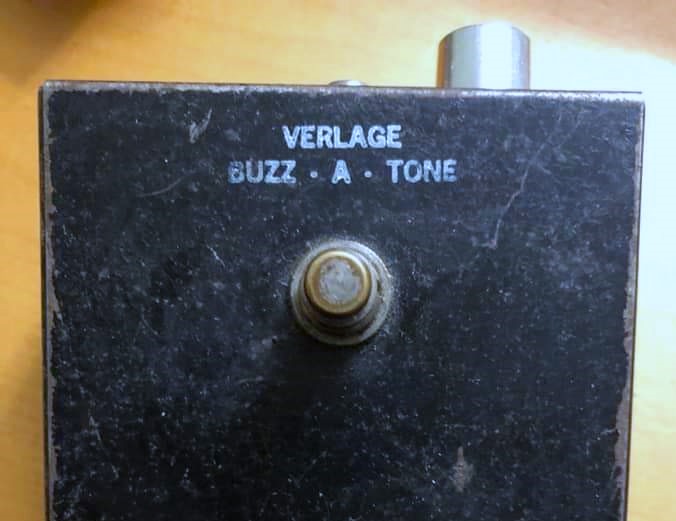
Verlage Buzz-A-Tone (Canada's First Fuzz?)

☟
Verlage Buzz-A-Tone


This past Summer I was probably spending too much time going through old magazine archives and looking for anything pedal-related. My main years of focus where 1962-1972, as the later half of that decade saw the birth of guitar pedals, and specifically FUZZ, as we know it today.

And as it turns out, I was very lucky in tracking down some really important ads and articles that have helped clear up much of the history we all thought we knew for the past couple decades. Additionally, I was able to discover some pedals that were completely new (to me), which then lead to even more digging and late-night research.

The article below, which was found in the June 1969 edition of The Music Trades magazine, highlights a "new" fuzz out of Saskatchewan, Canada called the "Buzz-A-Tone". As you can imagine, I immediately had to find out everything I could about this thing, and see if I could track one down for myself (spoiler alert: I didn't). So here we go! This is everything I have found, so far, about the Verlage Buzz-A-Tone fuzz...

Verlage Buzz-A-Tone

Verlage was an amp brand out of Humboldt, Saskatchewan, owned and operated by Ken Verlage. From what I could find, it looks like they were around for nearly a decade; from approximately 1965-1975 (give or take a few years).

The amps are somewhat rare, but I have been able to find photos of enough of them that seem to prove, if nothing else, how long they were actually in business.  

I did find one description of an early amp head that supposedly has the Buzz-A-Tone circuit built-in, but the controls don't really match up, so I cannot confirm if this is true. 

Verlage Buzz-A-Tone

So after a bit of onlining, I was able to find photos of two (somewhat) surviving units. Sadly, both have been modded; one has a weird 2nd footswitch installed, the output cable is missing, and I'm not sure what else could be wrong but it doesn't seem quite right. The other one has been completely gutted! At some point along its path, someone decided they hated fuzz and took out their anger and ignorance on an innocent vintage pedal just trying to live its life.

But that all being said, we at least have a couple photos to share so you can get an idea of what these looked like. And you may recognize that they appear a bit different than the one in that article above. 

*About that; one thing I caught at the end was the line,  "A special lead guitar model is also available."  So are we seeing both models here? I'm honestly not sure at all, but maybe YOU have one just sitting in your closet and would like to message me so we can figure this out??? 😁

Verlage Buzz-A-Tone


Verlage Buzz-A-Tone

Now that article being from 1969 should be an indication of when these were available. But something I have learned from reading The Music Trades, is that when gear makes it into an issue, it's because they are working with a distributor. And oftentimes a new brand will be toiling away for a year or two (sometimes more) before deciding they need a little help to expand.

So it begs the question, "When did the Verlage Buzz-A-Tone actually get released?"

And maybe we never would have gotten closer to that answer, but just earlier today I was going through old newspaper archives and came across an ad from the Brandon Sun, out of Manitoba, Canada, from August of 1967; it was for Verlage Amplifiers, and right there about half-way down, was a clear mention of the Buzz-A-Tone! (well "Buzz Tone", which might actually make sense. Look back at that 1969 article and the face of that pedal appears to have the word "Verlage" above the footswitch, and then simply "Buzz Tone" below it. 🤔)

Verlage Buzz-A-Tone
Now I don't personally know much about the pedal history of Canada. But I can't think of a single Canadian fuzz that came out before 1967. So could this be the very first (production) fuzz box from our neighbors to the north???

And if it was built in 1967 or earlier, what could the circuit be based off of? Unfortunately we have no gut shots to study, but it could easily be a Maestro Fuzz-Tone or even a Mosrite Fuzz-Rite. But to be honest, we will have no idea until we actually see inside one.

And just to be thorough, I should mention that one of the owners has described the tone as sounding "like a Fuzz-Rite", but again, who knows!?

Well, that's all I got for this one! If it wasn't clear above, I will ask you all now; if you have any more information on the history of Verlage Amps or Ken Verlage, please reach out.

If you own a Verlage Buzz-A-Tone definitely reach out! If nothing else I would love to see the inside of one so we can come back and edit this with more details and accuracy. Here is
my Email and Instagram please feel free to reach out with any additional bit of info you might have.

*And if you'd like a little more background on the amplifier side of Verlage, check out this link.

Thanks as always,
-ed

Sunday, December 29, 2024

History of the Companion FY-2 Fuzz

☟
Last week I posted a new video on the history of the legendary Companion (Shin-ei) FY-2 Fuzz, and specifically the early germanium version! I will follow this up in the next week or so with a post about some things I may have missed in the video, plus a clarification or two... 
But for now, I hope you enjoy this super deeeeeeeeeep dive:


Thanks for watching!
-ed