Thursday, June 11, 2026

History of the Elk Big Muff Sustainar

☟
This is one I've been working on for a while. 

There's still some unanswered questions and puzzle pieces out there just floating in the ether, but at this point I feel like we have enough for a decent article.

So let's dive in, to the previously unknown history of the Elk Big Muff Sustainar.

This is going to be a long one...


Back in 2017 a listing popped up on Reverb.com for three Elk Big Muffs. Up until then it had been extremely rare to see one for sale in the US, let alone three different versions all at the same time! So without hesitation I pulled the trigger and snatched them up.

By that point it had become common knowledge in the vintage pedal world that there were a few different versions of this infamous Japanese Big Muff clone; the Elk Super Fuzz Sustainar, the Electro Sound Big Muff Sustainar, the Elk Gakki Co. Big Muff Sustainar, and the unbranded Big Muff Sustainar. Additionally, there were also two more oddities in the mix; the Maccanbell Big Muff Sustainar, and the This Sounds Better Big Mag. All of which were very hard to find, and any information about them was nearly impossible to track down, save a flight to Japan. 

And if you're a regular reader here then you know that any time there's a combination of, Pedal + No Hard Evidence, it almost always = Misinformation. Which is exactly what happened with the Elk. The story ranged from "These were made as early as 1970!" to "we've only ever seen really clean examples of the Elk Big Muffs, so maybe they were made in the last decade and just appear old!" And this could have gone on forever, but finally in 2018 a very pixelated 1974 Elk catalog surfaced on the internet, and inside you could clearly see an ES-960 Super Fuzz Sustainar!


Now that I knew they were indeed vintage, and pictured in a catalog, it was time to start digging.

So over the next few years I was able to find even more appearances in print, along with photos of the actual pedals. By 2020 the Japanese market was beginning to open up to the US, and more and more resellers were not just willing to ship across the world, but actively listing on sites like Reverb.com and Ebay. 

With each new piece of evidence we were beginning to get a (sort-of) clearer picture of the Elk Big Muffs. And in 2022 we got this important breakthrough when one showed up for sale with its original box! (*note, the knobs are NOT original on this unit)


But while we felt like we were making some ground on the history of the Elk Muffs, there were still loads of unanswered questions.

So in 2024 I made it a mission to seek out all of the Elk catalogs I could possibly find. And with the help of my good friend Marcelo from Guitar Restos, we were able to track down pretty much every Elk catalog and brochure from 1970 - 1976! 

The earliest appearance I could find of the Elk Super Fuzz Sustainar was from a 1973 Elk catalog. Listed as the "ES-960 Super Fuzz Sustainer" it sat right next to Elk's other pedal offering at the time; the WF-880 Wau Fuzz. The following year's catalog would replace the WF-880 with the WF-1100 Wau-Fuzz, and also include the WS-1400 Wau & Sustainer. Either version of the Wau-Fuzz was clearly made by a third-party manufacturer (and possibly even an OEM deal) because the same pedal could be found as early as the 1971 Guyatone FS-5 Wah-Fuzz. The Wau & Sustainer was even more interesting because it seemed to be a Big Muff circuit + Wah, but neither the transistors or the clipping diodes match those used in the Super Fuzz Sustainar. The enclosure is a clear ripoff of the Cry Baby, which we also see in the Ibanez/Maxon/Greco Blubber Wah and Pedal Phaser; which all lead me to believe that these brands simply purchased from the same supplier and slapped their logos on the effects, rather than manufacturing them in-house.

Unfortunately even though we were able to find all of these catalogs, we seemed to hit a dead-end when the Big Muff completely disappeared in 1976. And after seeing the two wah pedals, that almost certainly weren't made by Elk, a new question arose; did Elk themselves even build the Big Muff Sustainar?


Above are photos from the Elk manufacturing facility in Utsunomiya from the mid 70s. And all together I probably have 10+ more images just like these, but zero of them show pedals being built. We see amps, guitars, possibly an Echo Machine in the one above, but no Wau-Fuzz, no Wau & Sustainer, and definitely no Big Muffs.

So WHO actually built the Elk fuzzes? This part of the story is one I am still trying to find answers to, but luckily there appears to be enough available info that we can, at the very least, create a timeline of when each version was released and which of them were official Elk products and which, probably were not...


June 1973, Music Life magazine, gave us not only the earliest image of an Electro Sound Big Muff, but also answered many questions we had been asking for years!

For one, it confirmed that the pedal had been released as early as 1973. This would have, in Japan at least, meant that the Elk version and the Electro Harmonix "Triangle" Big Muff could have potentially been sold side-by-side (which is kind of hilarious to think about).  This also means that it was, almost certainly, the earliest Big Muff copy to have been made in Japan, beating out the Ace Tone FM-3, the Mirano Exciting Fuzz, and the Sekova Big Muff.

This ad also confirmed that the Electro Sound Big Muff was 100% an Elk product. Very few people were ever questioning this, but there are other ads, that we'll post soon, showing "Electro Sound" as the manufacturer, which did make it somewhat confusing.

And maybe the biggest question answered, in regards to the "Big Muff" labeled version, is which came first; the SustainAR spelling, or the SustainER spelling. And as we clearly see on both the ad and the pedal itself, the "ER" spelling was indeed the original.


Just two months later, in the August 1973 issue of Music Life magazine, we get two ads featuring the pedal. But this time they are divided as the Elk "ES-960 Super Fuzz Sustainar", and the Electro Sound "Big Muff Sustainer". With the latter now stating that "Electro Sound Co." is the manufacturer.

They even went as far as putting completely different addresses and contact information for both brands. Which I found odd, because it's clearly the same company selling both. Even the image on the box from the Elk, that we posted up above, is the same sketch of Santana that's in this Electro Sound advertisement. So what was actually going on here?


Enter, my favorite ad from this era. Deep in the pages of the 1974 Music Mita instruments catalog is this ridiculous section showing an Elk Super Fuzz Sustainar at the bottom and an Electro Sound Big Muff Sustainer at the top. Although you probably, and very quickly noticed that it says "Electro Harmonix" under the pedal!

In the early 70s Electro Harmonix had almost no distribution outside of the US. This led to some very blatant copies (and in the case of the Soviet Union, very blatant counterfeits). And while I have no evidence for this statement, I believe that Elk could have intentionally named the brand "Electro Sound" in order to confuse and potentially mislead their customers into thinking they were buying a true Electro Harmonix product.

If this is accurate it would explain the two brand names, the separate ads, the two different addresses/contact numbers, the different spellings of "Sustainer/ar", and also this Music Mita catalog. But again, total speculation on my part.


Moving on from my tinfoil hat conspiracy theories, in the Spring of 1974 we get to see two more ads for the Electro Sound Big Muff Sustainer. One, showing a wider silver-topped knob and the other showing the same black knobs we've already seen. 

Both of these were listed as being Elk products and have those cool, but completely unnecessary descriptions of what each part of the pedal does. lol  
 
I have to imagine that Elk was in possession of the two examples above of original Electro Harmonix Big Muffs in order to make their copies. But unless we talk to someone who was there in 1973, there's no way to know for sure.


Throughout 1974 and 1975 Elk continued to use the "SustainER" spelling in their ads and on the boxes, but the pedals themselves appeared to have all changed over to the "SustainAR" spelling (some time in 1974).

In September 1975, from what I can tell, Elk discontinued (or at the very least, stopped advertising) both the Electro Sound Big Muff Sustainer and the Elk Super Fuzz Sustainar. Instead they introduced the "New Big Muff" under their Elk Gakki Co. brand.

This tends to be the most common version of the pedal, and were made seemingly by the thousands. It's very possible that production even lasted through to the end of the decade.

Taking all of this information into account, a basic timeline has started to emerge; with the Electro Sound Big Muff Sustainer coming first, then almost immediately after, the Elk Super Fuzz Sustainar, then finally the Elk Gakki Co. New Big Muff Sustainar. But it would take looking inside these pedals to get an even better understanding of what came when.


Pictured above is what I believe to be one of the very earliest examples of an Electro Sound (Elk) Big Muff. There are a few details that immediately stuck out to me the first time I saw this that were completely different than any other Elks I had seen before.

First is that small "Elk Inc." sticker on the front of the pedal. Which I originally thought was put there by a past owner, but since I discovered this example I have found 3 more just like it (same sticker, but the placement can vary).

The second is that circuit board. Not only is the shape not a perfect rectangle, like all other Elk Big Muffs, but the PCB layout is totally different as well! It's clearly the same circuit, and mostly the same components you'll find the early rectangular boards, but they apparently chose to redesign it at some point so that the Sustain pot wouldn't need the additional real estate. I have yet to find one for myself so I can not comment on any tonal differences, but even within the three I do have, they all sound drastically different. So at least Elk's inconsistency was authentic to Electro Harmonix's.

This was also the first time I noticed the difference in spelling with "SustainER", and after seeing the early ads determined that most likely this was the original version of the pedal. It's definitely possible that the added "Elk Inc." stickers were done for some shops that preferred to have their branding on the pedal, and if these predate the Elk Super Fuzzes then this would make sense, as there were no other options at the time? But as of now, we can't say for sure.


So if the last pedal was "V1" then this would be considered "V1.b". It's essentially the same exact effect, but in the "Elk Super Fuzz Sustainar" labeling. And had I not seen an Electro Sound like this but without the "Elk Inc." sticker I would have just assumed that it came out the same time as the V1.

Both of these were very short-lived, as they're still difficult to find. But with the amount that have shown up over the last decade I would guess that somewhere between 500-1000 were probably produced.

Again, the sound in every version (and even unit to unit) tends to vary enough that it's hard to say one sounds "better" than another. The transistors used in both V1's are silicon 2SA495's. Which you're about to see is just the first of many that Elk will use along their Big Muff journey.


Next we move on to what I would consider "V2". And with it, we see a couple big changes.

The first is a brand new PCB layout and board shape. One that Elk will continue to use all the way through to 1976/77. Another small detail is the battery holder changed from the exact style that Electro Harmonix used in their pedals to a folded metal style that again, Elk continued to use throughout the remaining versions. Other than resistor choice, the general component selection is the same; including the 2SA495 transistors. And while I haven't mapped it out, I would put money on the circuit being identical to the V1.

The next big departure here is the Electro Sound version has switched over to spelling it as "SustainAR". I'm really curious why this decision was made, or even why they spelled them differently in the first place, but for whatever reason, now both the Elk and Electro Sound pedals spell it this way. 

Oddly enough, three contemporary Japanese Muff copies chose to stick with the American spelling; the Guyatone FS-6 SustainER, the Aria Distortion SustainER, and the Aria Super Fuzz SustainER (which I feel it's safe to assume was a rip of the Elk). 


The switchover date to V3 is hard to pin down. While the new knob selection should have made it easy, I have yet to find anything in print where Elk highlighted these updates. So as of now my best guess is, "some time in 1974". 

That being said, some time in 1974 (or maybe even '75) Elk introduced two new knob options on both the Super Fuzz Sustainar and the Big Muff Sustainar. In addition to these cosmetic changes they also made a handful of updates to the circuit itself; keeping the same basic layout but changing the transistor type and some resistor/capacitor values.


Above are three different examples of the V3 Elk Muffs. Each one features four 2SA733 transistors, and a mixture of different components, but going off of possible dates on the caps, it seems as though they were all built within a year of each other.

Again, it's hard to know exactly when each of these were made, or if there's any relation at all between build-style and timeline. But what we do know is that a ton of V3's were made, and most of them featured the black Radio Shack knobs. The silver top hat knobs I wouldn't consider "rare" necessarily, but they were used significantly less. 

This era is still a bit of a mystery, but luckily for us Elk had big plans for the Fall of 1975...


In the September and October issues of Music Life magazine Japanese fuzz fanatics would get their very first look at the NEW Big Muff Sustainar (or for the purposes of this article, "V4"). With a complete cosmetic overhaul, nearly everything about the look had changed. A new "Big Muff" logo, a new almost cartoonish font choice, a dark blueish text, a new set of knobs, and even a new company name, Elk Gakki Co.,

But, initially at least, the New Big Muffs would use the same exact PCB and component selection as the V3's. Even the same 2SA733 transistors were used, which most likely means that while they discontinued the older look of the pedals, they planned to use the already populated boards for the new design. And since the enclosures are identical, it may be safe to assume that they could have stripped them clean of the V3 text and replaced it with the V4?


Next up was what I'm calling V4.b. This unit again uses the same V3 PCB and the majority of the same components, except there was a brief switch over to the classic 2SC828 transistors (most notably used in the Univox Super Fuzz, and were also used in the Maxon D&S / Ibanez OD 850, which may or may not have a deeper connection here). And I haven't yet taken the time to see if any component values changed, but it is a possibility as well. (*note, I have found 3 examples of a V4.b, so I felt it was safe to assume this was a legitimate build)

This is a little harder to confirm without holding one in my hand, but I also believe that Elk moved from the dark blue text back to black for the V4.b, which would continue through to the final run some years later.


From 1975 on, it's difficult to pin down exactly when each new version was released. Which means we don't have the hard evidence to say 100% that this one came next and what year that happened. Either way, I do feel very confident that this ("V5") was next.

V5 kept in line with V4.b when it came to cosmetic appearance, but inside it was a complete overhaul! New PCB layout, a new way to mount the board, new component values, new 2SC495 transistors, and a tonal departure from its predecessors; the "NEW Big Muff Sustainar" could finally live up to its name.

Judging by the sheer amount of V5's that still exist I would have to assume that they were manufactured for a much longer duration than any previous version. But as of now, that's still a bit of a guess. Either way, if you happen to buy an Elk Gakki Co., Big Muff there's a good chance that the circuit pictured above is what you'll find on the inside.


Much of the information for this article was gained through mining the pages of Japan's Music Life magazine; mostly issues from the years 1973-1976. So there is a good chance that more info is still out there waiting to be discovered.

Luckily, reader of the blog, Pedakichi, reached out about a month ago and sent me a few Elk Big Muff related ads that I had yet to find. One of which is from an April 1979 issue of Music Life (see above).

It's hard to tell exactly what is going on in the full page, as it appears to be an ad for an upcoming guitar show. But in the bottom corner is this section where they highlight an Elk Gakki Co., Big Muff Sustainar (that seems to be used?). So with only this confusing bit to go off of, we can't say for certain that Elk was still selling the pedal this late.


Living completely in the land of mystery are the This Sounds Better Big Mag and the Maccanbell Big Muff Sustainar. Between the two, I was able to find a "Maccanbell" branded guitar online, so I'm guessing it was either a music shop or small distribution company? But unfortunately I have found no information for the hilariously named, "This Sounds Better" brand.

As of now we don't know who made these, when they were released, or where they were sold. But after looking at photos of the two it's plain to see that they are identical to each other, and were certainly made by the same manufacturer. They both use the same combination of components, including 2SC710 transistors. And another clue is that they both feature an on/off LED, which did not become commonplace until the early 80s. Another indication that they were possibly made around this time is that the pedals themselves are much smaller than all of the Elk branded versions. The Boss and MXR influence had really changed the pedal game by 1980.

There are some additional clues here that point to a relation between these and the Elk pedals. For one, the layout of the PCB is very similar to the V5 Elk Big Muff, and of course that odd vertically mounted board that's also found in the V5. Another interesting thing I noticed was that the font used for the control knobs and the jacks is the same exact font found on the V5 Elks.

So were these the true successors to the Elk Muffs (the V6)?

It's very possible, and if they were made in any other country I would feel quite comfortable assuming that was the case, with all the similarities we've found. But this is Japan... and one thing I have learned is that stuff just worked differently there. So it's possible that Elk themselves had nothing to do with this, and if they were using a third-party manufacturer the whole time maybe that company tried to continue building the pedals after the Elk deal was done, and these were the only two clients they had? Another option, is that a completely different manufacturer just straight up copied the Elk Gakki Big Muff, shrunk it down, added an LED, and licensed it to these two random companies?


Here's the one you've all been waiting for me to talk about...

I promise I didn't forget it! What has become affectionately known as the "Wata Muff" (based on the legendary Boris guitarist, and inspiration for Earthquaker Devices Hizumitas fuzz) is long thought to have been the earliest and original version of the Elk Big Muff Sustainar.

Unbraned, with that oddly-chosen-font "Big Muff" blazoned across the front, this is the one that everyone seems to want! But what's the deal with it? Did these really come out first? And were they even made by Elk?

Let's have a look, and you can decide for yourself.

The unbranded Big Muff Sustainar is a bit of an outlier when compared to the Elk units. In addition to the obvious, it also has differences like the font for the control knobs, different transistors, and those strange yellow and black clipping diodes. The PCB layout doesn't seem to match any version of the Elk, and even the battery holder piece is cut to a smaller width (*note, the earliest Elk/Electro Sound Big Muffs used a completely different battery holder style).

One glaring piece of evidence that, at the very least, points away from this being the "original" version, is that it uses the name "Big Muff SustainAR". Because we now know from all of the earliest advertising that the Electro Sound Big Muffs spelled it as "SustainER". Another important difference is that PCB layout, which seems much closer to the V5 Elk Gakki Big Muffs than it does to any V1's (but it is important to note that the unbranded Big Muffs and the Electro Sound Muffs both use PNP transistors, while the V5 Muffs switched over to NPN, suggesting it was a copy of an earlier version). And while the unbranded version above appears to have ceramic capacitors dated to August 1973, the Sustain pot (and it has now been confirmed that all 3 pots share the same code) was clearly dated to 1976 (although earlier codes have been seen on other examples, giving us a potential date range from 1973-1976 for these).

This is all to say that I now have big doubts that this either came before the Elk/Electro Sound Big Muffs, or was even made by the same manufacturer! But if it had no relation to Elk, then who was responsible for the unbranded Big Muff Sustainar???


The Pearl CF-1 Cry Fuzz is a Japanese-made fuzz wah that's probably from the mid-70s. And while it's most recognizable feature is the completely ridiculous sketch of a baby peeing on the logo... it's also known to possess a particularly great sounding fuzz circuit.

One day a little while back I was randomly looking through photos of the Pearl, trying to figure out what type of fuzz it used, and then I noticed something I hadn't before. The Pearl had two sets of clipping diodes, and appears to use 4 transistors for its fuzz section. It was almost certainly a Big Muff variant and even showed similarities to the Elk Wau & Sustainer  (as more of an inspiration than a descendant).

But the next realization I had was that the clipping diodes were the same, very unique, yellow and black ones found in the unbranded Big Muff Sustainar. And not only that, the Pearl also used the exact same 2SA564 transistors that the unbranded Muff uses! And upon further inspection, I realized that the circuit in the Pearl is nearly identical to the one found in the Elk Wau & Sustainer (which is essentially a Cry Baby wah circuit with a Big Muff attached). With the main differences being the circuit layout and that instead of using an inductor for the wah, it uses a transformer (which oddly enough, is what you find in the Elk Wau-Fuzz!). 

So is this a scenario where a totally different manufacturer is essentially copying Elk and just selling the pedals as an OEM situation? Is it also possible that the Pearl could be an earlier (or later) build by the same manufacturer of the unbranded Big Muff? And if so, who was responsible for all of this?!


*WARNING, you now are about to enter into:
The Complete Speculation Zone!

You may remember our last post where we talked about the extremely rare CS. Cathey pedals, and particularly the AS-01 Sustainer fuzz from that series. Going by the description and control labels alone it really sounds like the Sustainer was a Big Muff copy. Unfortunately we weren't able to find any photos of what's inside those, but there was a possible clue hiding in the knobs that were used. Featured on Univox, Sekova, and Melos branded effects, those tall black silver-top knobs are not found in very many other vintage effects. And the tie that binds them all is Melos. So is it possible that whoever was responsible for building the Melos pedals also built the CS. Cathey Sustainer? 

If you're wondering why I'm bringing this up, it's because the Pearl Cry Fuzz uses the exact same knobs. And after doing some more digging, I figured out that both the unbranded Treble-Bass Booster (which may or may not have a relation to Melos) and the Melos FL-1000 Flange/Delay use the same 2SA564 transistors found in the Pearl and the unbranded Big Muff Sustainar. So what are the odds that a single manufacturer is responsible for all of these pedals? All of them, except the Elk Big Muffs that is.

Obviously this argument is a bit flimsy, but I think we can all agree that there's at least more evidence supporting this idea than the long-held belief that the unbranded Big Muffs were made by Elk.

BUT ED!!! WHAT ABOUT THAT UNBRANDED BIG MUFF WITH THE ELK STICKERS???!!!


I am well aware of this pedal.

It first appeared four years ago on a certain Japanese gear seller's Youtube video. And then again just last week when it apparently sold.

The lore of the unbranded Big Muff goes way back to at least the mid-2000s, and even then it was thought of as being an official Elk product, sans evidence. That considered, I don't really know what to make of the two "ELK" vinyl stickers haphazardly stuck to either side of this pedal.

Neither the sticker style or even the logo itself matches what we saw on the earliest Elk Muffs. And I could not find any other examples of an unbranded Big Muff with even the faintest outline of past sticker residue on its sides, let alone another one with any type of "ELK" branding. But I supposed we have to at least leave it open to possibility.


Could it be that Elk contracted two separate manufacturers to build their Big Muffs? But if that was the case, then why are there dozens of ads throughout the 70s for the Elk Super Fuzz and the Electro Sound Big Muffs, but there are NO ads (at least that I have found yet) for the unbranded version? 

The logo on the stickers appears in Elk catalogs at least as early as 1972. And I was able to find an additional example of one (albeit a different type of paper was used) on what looks like the side of an amp, but it's hard to tell for sure what amp, and sadly there were no more photos available. 

There's also another thing about this particular pedal; which is the obvious outline of a circular sticker that clearly used to be on the front of it, right in the middle overtop the logo. So we have evidence that at some point an additional sticker was placed on this unit and later removed. To me at least, it's very unlikely that any brand would cover up the name of the pedal itself in this fashion. But what do I know?!


Well this was definitely a super long one, but I promise it was all necessary to suss out what was going on with this iconic piece of fuzz history.  So thank you for sticking it out and reading this far. I hope you got something new out of it! 

And like always, if you happen to have any additional info on Elk that you think could help us, or if you know anything about the unbranded version, please leave a comment or feel free to send me a message via Email, Substack, or Instagram!

thanks again,

*after posting this we made a few more big breakthroughs that I will present as a new post in the near future! So watch this space for those updates to our evolving history of the Elk Big Muff. :)
-ed

Friday, May 15, 2026

Mystery: Solved!!! ( Yura Yura Teikoku )

☟
This tiny, blurry, illegible image that you see below just unlocked a 15+ year mystery. I was looking for pdf's of old Japanese Rock magazines and despite its size, this little photo caused me to do a complete double-take. The unfortunate part was there was not a larger version (which was pretty damn unfortunate for me). But the good thing was that it existed at all, AND I knew exactly where it came from... 

Tsumetai Gift CS. Cathey Effector


In 2010 a truly legendary music video was making its rounds through the various vintage pedal forums; the song was called "Tsumetai Gift" ( 冷たいギフト ) and the artist was Yura Yura Teikoku. The track was actually from 2003, but was only then being discovered by a group of enthusiastic American nerds some 7 years later. (*see video below)

The concept for the first 3/4 of the video seems to be, "look at how awesome vintage pedals are!", as it opens with an original Honey Baby Crying Fuzz on a rotating platform, before giving way to a seemingly endless line of pedal grail after pedal grail.


Back on my favorite forum at the time (the D*A*M forum), we all came together and attempted to name every pedal highlighted in the 06:14 video. There were a handful of obscure oddities, but after just a couple weeks of sleuthing we were able to pin down all but one. And as accomplished as we should have felt, that one pedal would haunt us for years.

Appearing at the 02:40 mark, with only two seconds of screentime, this large box that kind of looked like an early 70s Maestro Sustainer, but clearly wasn't, became an instant cypher to crack. The colors were correct (Black & Green) and the general design was similar to the Maestro, but the graphics were wrong, the enclosure was off, and it just wasn't it. But could it be an early clone or something?

Tsumetai Gift CS. Cathey Effector

Yes, the video was shot in Japan, but it featured pedals from all over Europe and the US as well. So could this be some foreign pedal that's just never surfaced before?

Everyone's best guess was that it was some kind of Russian/USSR pedal from the 70s or 80s. Most likely a clone and probably of the Maestro Sustainer. And at the time this felt the most "right", as there are still plenty of Soviet-era pedals being found in 2026, let alone in 2010. And many of these are so close to actual units made by Electro Harmonix, for instance, that they border on "counterfeit" territory rather than a simple clone.

Tsumetai Gift CS. Cathey Effector

And for years, the "it's probably some Eastern European pedal" theory was the best we had. It never showed up for sale on either Reverb or Ebay, or even any of the Japanese or Euro auction sites (as far as we knew anyways).

Well unbeknownst to us, on the other side of the world there was a group of likeminded pedal nerds in Japan who where attempting to do the exact same thing. And just like us, they too were getting stuck on the black and green mystery pedal. But they did have one bit of info we didn't, which was the owner's name of this amazing stash; Souichiro Nakamura, owner and acclaimed producer/engineer at Inter Music studio, later renamed "Peace Music", who recorded the song in question. (*see his crazy collection below)

When asked about the music video he admitted that many gear geeks had inquired about that specific green/black pedal over the years, and no one had ever figured it out (nor was he willing to give up the answer). So this led to even more best-guesses and forum debates, with the current consensus being that it must have been some vintage Korean pedal, possibly a copy of the Maestro Sustainer, that has just never shown up again...

Tsumetai Gift CS. Cathey Effector

So by now, if you are a regular here, you know that I can't get stuff like this out of my brain. It haunts me. 

And while I hadn't been actively seeking out that specific pedal over the years, I would immediately recognize it if I saw one. Which brings us back to that tiny, blurry photo at the top of this article.

As I stated, I was in the middle of one of my nightly internet rabbit hole scrolls when I came across that image, from a December 1975 issue of Music Life magazine (picture Japan's equivalent of Hit Parader). It was about as tiny of a scan as I've ever seen and impossibly pixelated, but luckily it wasn't obscured enough because I instantly knew what I had stumbled upon.

My very next step lead me to a Japanese auction site where I found the exact issue of Music Life that hopefully contained the image. I hit the "buy now" button, filled out the necessary forms, and the wait began...

Tsumetai Gift CS. Cathey Effector


And here it is!!!

After 15+ years of searching for the mystery black/green pedal from the Yura Yura Teikoku video, we have finally done it!

What you're looking at is the CS. Cathey effects series. Featuring the AS-01, AD-02, AB-03, and AO-05. The AS-01 Sustainer, being the pedal from the video, is described as a "Soft Fuzz" effect that is "popular these days". Which makes me think it was a Big Muff copy as they were extremely popular in Japan by 1975 (the Elk Super Fuzz Sustainar, the Guyatone FS-6 Sustainer, and the Ace Tone FM-3 Fuzz Master were all out by then). The AD-02 Distortion Box is described as a "return to the origins of fuzz", with a "powerful sound" and intense distortion effect. Could this possibly be a Tone Bender copy? The AB-03 Distortion /Booster is described as a booster that can get into distortion territory. This makes me think it's some kind of overdrive effect, but it's hard to know for sure. And finally the AO-05 Upper Octave is exactly what you think it is. The description makes it sound like an Octavia or Green Ringer style effect.

Tsumetai Gift CS. Cathey Effector

While we were able to get amazing hi-res scans from the magazine, unfortunately the original images left a bit to be desired. So it's still impossible to make out the logo or text under each control knob. But if I had to guess, based on the description, I would put my money on "Volume", "Tone", and "Sustsain". 

Another interesting thing that comes up in the description is that each pedal featured an On/Off switch built into the "Volume" pot (think, Maestro FZ-1). And they all run off of two 9v batteries (think, Rozz Dead Heat, although this would have almost certainly predated the Rozz). 

One final, and possibly insignificant aspect, is the knobs. It's hard to tell from either the scanned image or the video, but they look very similar to the knobs found on some 1970 Univox effects, and the final version of the Sekova wedge fuzzes. I have long believed that whichever factory made the Melos effects also made most of the Univox pedals, and that possibly these knobs were some indicator of a connection? It's a longshot, but worth pointing out.

Tsumetai Gift CS. Cathey Effector

So that's it! We finally did it. 

And I was feeling super accomplished yesterday putting all of this together, and this is normally where the post would end. But then I remembered a random Twitter post I came across last year where people were discussing and trying to list the pedals from the Yura Yura Teikoku video. And yet again, they were getting stuck in the same spot. But one response lingered in my mind, and I thought to myself, "I should go and look at that again, just in case!".

The commenter went by the name Pedakichi, and I remembered that he posted a pretty convincing illustration, that I assumed he drew from memory, possibly after physically seeing the pedal long ago:

Tsumetai Gift CS. Cathey Effector

THAT'S IT!!! 

Pedakichi knew exactly what the pedal was. And when I checked out his own posts, I not only came across 4 separate mentions of the CS. Cathey line, but also his description of the magazine where he discovered the image... and it did NOT sound like the same one I had found.

So I went and signed up for a Twitter account and sent him a message asking if he had any further info on the brand.

Tsumetai Gift CS. Cathey Effector


Tsumetai Gift CS. Cathey Effector

Well Pedakichi (ペダ吉) came through big time! And sent me a handful of images, including his own rendering of what the pedals probably looked like based on the descriptions in the advertisement above.

He also noted that the earliest mention he was able to find about the CS. Cathey line dated to October 1975, and the latest was April 1976. So a short window for sure, and one that probably ads to the impossible rarity of these effects. A rarity that even after I found the initial advertisement last week, I considered the possibility that they were a case of vaporware; conceived, advertised, but never brought to market. And somehow a "prototype" just made its way onto the set of the "Tsumetai Gift" video.

But now that we know they were adequately marketed, and lasted at least 6 months, the reason for their rarity almost has to lie somewhere else. Maybe they just had poor or no distribution, and you could only get them from a couple shops in certain neighborhoods? Who knows! They weren't any more expensive than any other effects at the time, and Japan certainly hadn't become so oversaturated with pedals by 1975 that they would have gone unnoticed. So yeah, that part is still a mystery. 

Tsumetai Gift CS. Cathey Effector

After seeing the image above it appears as though my guess about the knobs was correct! But obviously that doesn't mean they have any connection to Melos/Univox. Just something for me to dig into more later.

My other guess on the knob functions of the CS. Cathey AS-01 was super close as well! I just flipped the order; so they actually run left to right, "Sustain" "Tone" "Volume", where the volume knob also acts as an on/off switch. That all considered, I am still sticking with my "it's probably a Big Muff" guess for now (or at least until someone finds one and comes forward!).

So my big grand discovery had already been discovered (thanks Pedakichi!), but honestly something like this is exactly what I hope happens more often. Don't get me wrong, I love being out here in the uncharted and nerdiest depths of guitar pedal history, but it saves so much time and effort when someone else has already done similar work and can meet me halfway to share their findings! No guesses, no lies, no need for grand theories, just hard evidence that shows that a pedal existed, when, and what it might have sounded like. 

So thank you to everyone who has reached out over the years, and to anyone who's doing their thing, deep in the cut digging up their own stompbox gold and willing to share it with the world.

Thanks as always, and if you happen to own a CS. Cathey pedal or have any more information, please feel free to reach out to me via Email, Substack, or Instagram!
-ed

Friday, April 24, 2026

Electro Harmonix Sold Kits?

☟ 
On the heels of the upcoming Electro Harmonix book, “Made on Earth for Rising Stars”, by my pals Josh Scott, Daniel Danger, and Dan Epstein, I figured I would add my own little “did you know!?” to the story. It’s a part of EHX lore that isn’t talked about often, nor is it as well documented as the background of the Big Muff or who invented the Memory Man. So let’s take a look and see what we can uncover about the enigmatic Electro Harmonix Kits of 1971…

Around 1966/67, with the explosion of Fuzz, a small subcategory opened up right alongside all of the new (and now legendary) pedals being released. For every Fuzzrite, Fuzz Face and Tone Bender, a new article was being written that showed young players how to build their own guitar effects right at home. And the majority of these articles, in addition to inspiring first forays into soldering, were also linked directly to order forms for DIY project kits.


The project kit fuzz could be found throughout newspaper and magazine ads/articles from this point all the way through to the mid 1990s! And in fact, building a fuzz pedal is still often included in the curriculum for students just beginning their electrical engineering journeys. But one aspect that is usually overlooked is the handful of brands that gave customers a cheaper alternative by offering DIY kit versions of their gear.

-----------------------------------------

In 1971 Electro Harmonix adopted this idea and began to sell their entire line in kit form and at a fraction of the price of the “factory built” options. EHX advertisements of the time would double as order forms; showing a list of pedals that you could simply check off which model you wanted and if you would like it pre-built or not. Then you’d cut out the form and mail it in with a personal check (remember checks!), and a month or so later a brand new EHX pedal (or kit) would arrive at your door - let the shredding commence. 🤘


But there’s just one problem with all of this; NO ONE has ever seen an Electro Harmonix kit before!

I have personally been collecting and looking into vintage pedals for over 20 years, and while I don’t keep up with every single sale or listing, I can confidently say that I have never seen an EHX kit, and neither have any of my equally nerdy pedal collector friends. Which makes me wonder, did the kits even exist at all, or are they just so indistinguishable from the regular pedals that you wouldn’t even know if you held one in your hands?

It’s long been a bit of a joke that the early Electro Harmonix pedals were not the best when it came to build quality. Poor soldering, wiring inconsistencies, and chaotic component variances are all hallmarks of that first series EHX released (1970-1973). So would we even notice a difference if we found an original kit built by a 14yr old?


Another idea to consider is that there were a few times where EHX listed models in advertising that (as far as we know) were never actually released! A perfect example can be found on the order form pictured above; the Tape Reverse, which most likely was later released as the Attack/Decay, has never been seen. There are also instances where model numbers just seem to skip one and go on to the next, suggesting they had possibly created a pedal and just couldn’t get it ready enough to release for mass consumption?

So I guess that’s it.

Maybe the Electro Harmonix kits were a classic case of vaporware, advertised for a short period in 1971 but never brought to market?


One night, about a year ago, I was in my usual pedal detective mode, scanning Effects Database when I stumbled across an entry for the EHX Hare-Lip Microphone Echo. It’s a pedal I’ve known about for ages, but because its rather, ummm, underwhelming, I never really paid it much attention. But on this day I decided to give it a click.

And right there, staring back at me in all its glory, was a KIT version of the pedal!!!

I couldn’t believe it, they were real!

And the craziest part was that these photos had just been sitting there on FXDB for over a decade.


Ok, so now we’re getting somewhere.

And yes, it’s not lost on me that the “law of large numbers” has nothing to do with my upcoming assessment, but that said; we now know 100% that the kits did in fact exist, and when built would look nearly identical to the regular factory-assembled product. This means there’s a legitimate chance that if you ever bought a 1971 Triangle Big Muff you could have unknowingly owned a kit version!

Alright, I’ll calm down now. sorry. 🤓

Let’s have a look at what else was inside this mystical box of awesomeness…


So we have a full enclosure, including the rubber grip pad that sticks to the bottom-plate (*sitting under the PCB). We also have a bag of components; with knobs, pots, switches, battery clip, etc. And we have what looks like a single long piece of green wire.

I can assume that when the pedals were being assembled in the EHX factory, whoever was on the line was given a very similar, if not this exact set of parts to work with. Really, the only thing that stands out as different is the single bundle of green wire. Because the majority of “Triangle-era” EHX pedals could feature up to four different colors and even smaller gauges of wiring than what you see above.


When we look closer at this pixelated baggie of parts nothing stands out as odd or unique. It’s basically exactly what we see in that era of EHX effects; D-shaft pots, black “pinch” style knobs, carbon comp resistors, green caps, and a blue battery clip.

So unfortunately everything I’m seeing here just reaffirms that if you own a kit version of an EHX pedal, you might never know for sure. Unless of course you find an unbuilt, in the box example (imaging finding a NOS Triangle Big Muff kit 🤯🤯🤯).

-----------------------------------------

By early 1972 the advertisements mentioning kits were gone, and the little company from New York, Electro Harmonix, would go on to change guitar pedals forever. I assume the build-it-yourself kit idea didn’t generate the kind of sales that would justify keeping them around. And with only a single known example that they even existed, it shows how few were probably ordered.

But, being in the game for a while now, I also know that stuff exactly like this is less rare than it would appear. This is the kind of thing that’s currently sitting in a junk box in someone’s basement. A project never completed, or even started at all; now abandoned and stored away with it’s friends the Nordic Track, the stamp collection, and that 3D puzzle of the Empire State Building. And while these relics are largely forgotten, they DO still exist; just waiting to be exhumed from the dusty embrace of time, and loved again.

So if you happen to have any guitar pedal kits from the 1960s/70s, I would love to hear from you in the comments. But if you have an original 1971 Electro Harmonix pedal kit, I NEED you to track me down and send a direct message via Email, Substack, or Instagram!

alright, thanks for reading,
-ed

Friday, April 17, 2026

The Woman Who (literally) Built Rock & Roll

☟ 
Over the last five years the internet has provided me with endless avenues of dopamine-inducing research tools for learning about the history of guitar pedals. One of which is the invaluable category of website known as the “newspaper database”. They host hundreds of thousands of printed articles going back to the 1800s, and within them I’ve been able to find previously unknown release dates for certain pedals, names and faces of company owners, and even full articles on the initial reception of “Fuzz” as a wild! new! sound in the early 60s.

But one thread that seemed to weave its way through all of these discoveries was that for the most part, women appeared to be responsible for physically building much of the music gear we now covet as classic “vintage grails”.

Electro Harmonix factory workers assembling guitar pedals in 1978.
credit: Rolling Stone

I knew that I could not be the first person to have this revelation, so I kept searching. And while there were plenty of articles written about specific women who influenced tech, and music in general, I was really only able to find this one article that highlighted the integral role women played in taking electronic technology from the grasps of the elite and placing it into (almost) every American home by the 1950s.

And even though I wasn’t able to find much, and this has to have been written about 10,000 times already, I still feel like doing my own guitar pedal-nerd take on the subject. So here we go :)

Elgin Watch factory, 1930. credit: Elgintime

What I learned from the ETHW article linked above, is that around the turn of the century it started to become commonplace to specifically hire women for factory assembly work. And with the proliferation of radio in the 1920s, these women shifted from things like mechanical watch assembly to more electronics-based manufacturing.

As the article states, this was something of a balance (although if we’re being real, it was probably much closer to an 80/20 split) between corporate exploitation, and feminine liberation. On one hand, the companies preferred to hire women because they could pay them significantly less than men for the same output. On the other hand; there is a certain level of freedom associated with getting out of the house and working, and of the equivalent jobs available to women in those days (sewing in sweatshop factories or manual labor), sitting down and soldering circuit boards all day was certainly preferred.

By the time the 1960s rolled around the idea of a factory filled with women working the production line was not only the standard, but every step of the process was designed to keep this machine in place.

Take the want-ads for instance:
credit: The Daily Breeze

Throughout the decade a “Help-Wanted” section divided by Male and Female could be found in the back of any local newspaper. The jobs for men were typically higher in rank/status; designers, salesman, foreman, etc. while the positions for women were relegated to the lower rungs of the workforce; secretaries, seamstresses, and of course electronic assembly workers.

The result of this was a specialized workforce dominated by women, who were responsible for building an extremely wide array of electronics. This would trickle down to nearly every piece of music gear one could purchase at the time. And when I say every piece of music gear, I quite literally mean everything from the transistors to the capacitors, to the footswitches, to the PCB’s.

The lone “boutique” builder phenomena was not yet in fashion, and those who did go into business fully by themselves were fighting a huge uphill battle against giants like Fender, Ampeg, and even smaller brands like Applied Audio (who built the Goya Panther Fuzz, amongst others). Nearly all of it was made in factories by a group of underpaid, but very skilled female engineers (you know what, yeah! they WERE engineers).

Fairchild Semiconductor assembly line, 1960,
credit: Marin Independent Journal

Sprague Electric factory workers test components,
credit: MASS MoCA

While I was able to find “female only” want-ads for nearly every well known electronics manufacturer in the 60s, two of them immediately stood out for playing a part in my favorite vintage fuzzes.

Fairchild Semiconductor was a leader in the production of transistors throughout the decade, and their parts can be found in everything from the Sam Ash Fuzzz Boxx to the Big Muff and countless others. But a company who’s components dominated early fuzz pedals was Massachusetts-based, Sprague Electric. I have seen their capacitors show up in pedals like the Manny’s Fuzz, the Maestro Fuzz Tone, and the ACA Fuzz King. But most famously, Sprague was responsible for the infamous circuit “blob” (precursor to the IC) found in Mosrite Fuzzrites from 1968-69, and later in the Nu-Fuzz by Rosac.

The original caption is already perfect, 1968,
credit: Bakersfield Californian

Speaking of; in an article from 1968 photographer Jack Knight took the reader on a factory tour of Mosrite of California. And in it, was this AMAZING photo above of technician Birdie Lewis hand-assembling Fuzzrites! This has to be one of my favorite images I have ever found in a newspaper database, and the main inspiration for this article.

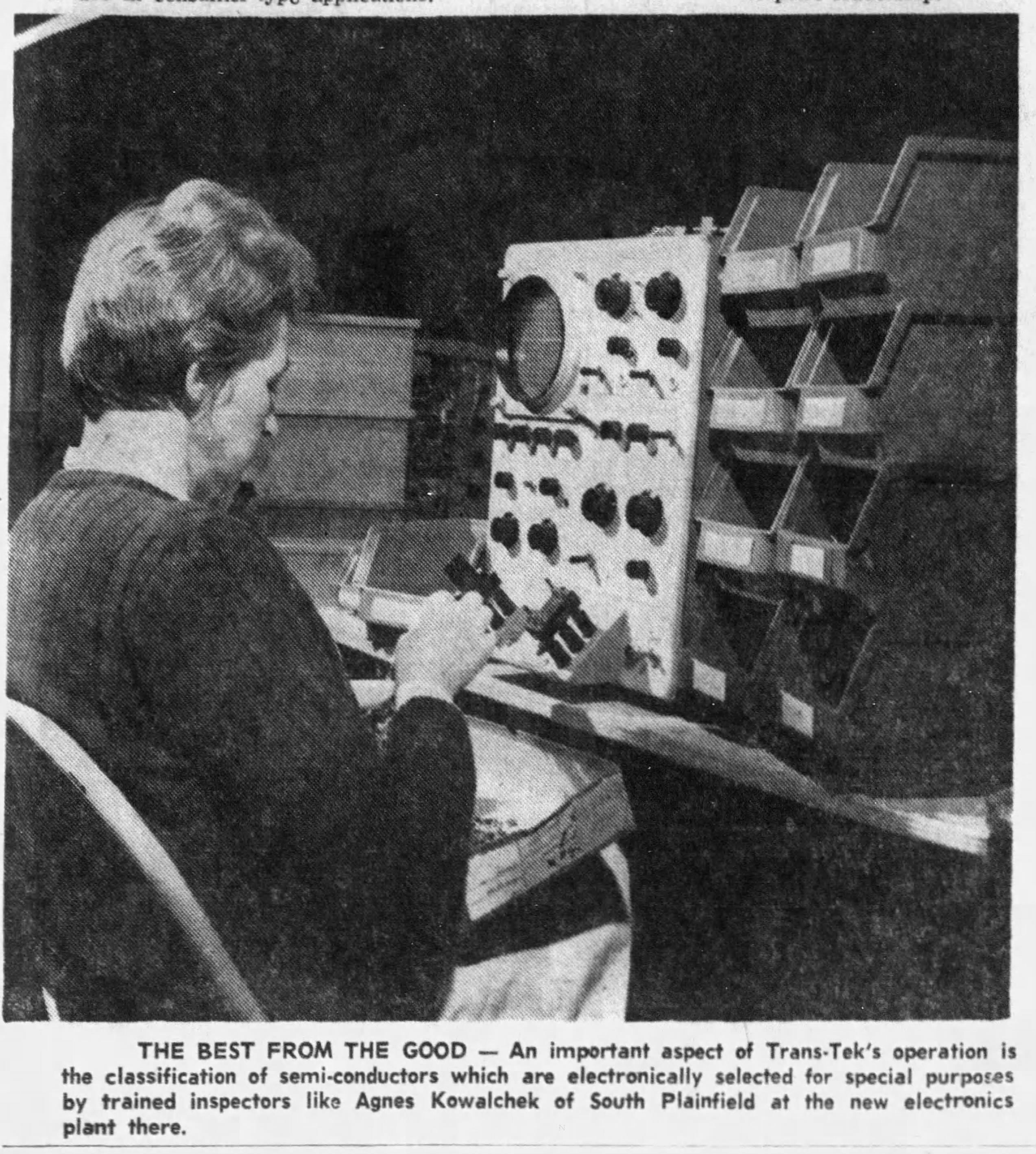
The other example that was directly related to vintage pedals is below. Trans-Tek Mfg. was mostly known for buying old-stock bulk electronic components from various sources (including the military), and then repackaging and selling them to both manufacturers and direct to customers. Additionally, their factory in South Plainfield, NJ housed Applied Audio (mentioned above), who’s fuzz pedals were almost as ubiquitous throughout the late 1960s as Maestro’s.

Applied Audio also employed a predominantly female staff who not only built guitar pedals and amplifiers, but also the wide variety of electronic gadgets that Trans-Tek offered (like DIY kits, home alarms, and hand-held radios). And workers like Agnes Kowalcheck had the important job of checking the quality and value of each individual component before it was put to use.

credit: The Central New Jersey Home News


Those hourly rates seem insanely low…
credit: The Central New Jersey Home News

This practice, while born in the US, was not confined to it.

Below is a completely ridiculous, and somewhat famous (infamous?) image from Japan’s Sony factory in 1960; showing a line of female workers taking their hourly stretch break, while being overseen by a whistle-blowing manager.

credit: Associated Press

Absurdity aside, I do think it’s important to shine a light on this overlooked/forgotten/unknown piece of Rock & Roll history. And for me personally, it was just a super cool epiphany I was having while digging through the past; and one I had never even considered…

“WHO was sitting down, day after day, actually soldering together all of these stompboxes that I love and have dedicated so much of my time?”

And when it started to become apparent that it was almost exclusively women, I was truly blown away. And mostly because I had never heard anyone tell this story before. 
(quick, someone hit up Ken Burns!)

----------------------------------------------

By the mid 1970s many of these manufacturing companies were moving toward a hiring preference for immigrants and people of color, who’s own struggle against prejudice and discrimination forced them to take whatever jobs they could, and as a result, whatever pay was offered. This move severely undercut the already insultingly low rate women had been getting, and ultimately led to their mass exodus out of the factories and into the same types of jobs men had been afforded for decades. And by the 1990s the majority of these electronic assembly jobs would be gone; sent overseas, where the exploitation of foreign workers still pervades today.

So while the irony of sitting here writing on my laptop, that was almost certainly made somewhere in Asia for pennies, is not lost on me. I truly do wish that those millions of workers also get their due-credit (and a living wage) some day in the near future.

Dolores Hacker assembling amplifiers at the
Sunn Musical Equipment Co. factory, 1967. credit: The Oregon Daily Journal

But for now, I hope at least some of you have gained a new appreciation for the thousands of women; our grandmas, aunts, and mothers, who in the 1960s and 70s constructed everything from amplifiers to microphones to fuzz pedals; the same gear that helped create the guitar tone on your favorite album, the mind-altering synth odyssey on your favorite track, and the unforgettable sonic explosion you experienced at your all-time favorite concert. These forgotten women deserve our recognition and their long-overdo flowers, for quite literally, building Rock & Roll.

thanks for reading,
-ed

Tuesday, April 14, 2026

I've Joined the Substack Gravy Train!


So a couple weeks ago I decided to take the blog on the road and try out something new (to me, anyways). I created a Substack account with the intention of having another place to post about nerdy pedal history, and hopefully cast a wider net so we can collectively pull in more hidden information about our favorite pedals.

The larger posts, will for the most part, be double posted here and on Substack. But I do like the "Notes" aspect over there, which acts like a mixture of Twitter and Instagram. So those posts will only be found on Substack. Pretty much it will be all of the in-between stuff that you don't typically see in the big finished articles over here.

So if that feels like anything you might be interested in checking out, thanks! Here's the LINK.

have an awesome week,

-ed

Thursday, March 5, 2026

Mirano Exciting Fuzz - The First Big Muff Clone?

☟
Mirano Exciting Fuzz Katayama

Back around 2010 I randomly came across photos of a cool-looking fuzz I had never seen before. It appeared to be a Mosrite Fuzzrite copy but with three knobs instead of two (à la the Pro Suzzzz Fuzzzz). 

After a bit of onlining I discovered, that in pure Japanese fashion, it wasn't a Fuzzrite at all, but a Big Muff clone! So now I was intrigued (no disrespect to the Fuzzrite)...

Mirano Exciting Fuzz Katayama

While it is much easier today, it's still quite difficult to research vintage Japanese pedals from here in the US. In addition to the language barrier, all of my typical fact-finding methods fall flat when it comes to anything made in Japan before 1980. But back around 2011 I did my best to find any information I could on the EF-1 Exciting Fuzz, and Mirano as a brand.

From the little bit I had access to at the time, a few things seemed to be agreed upon; 1. is that it was indeed a Big Muff "style" fuzz, 2. "Mirano" was the house brand for the manufacturer Katayama Denshi Gakki Co., Ltd. 片山電子楽器(株) (aka, Katayama Electric Instrument Co.) 3. the same company would also go on build the Rozz pedals, probably most famous for their own Big Muff copy, the legendary 18v DH-01 Dead Heat, 4. the Exciting Fuzz was released very early, possibly even in the late 60s!

And it was this last point that caught my attention the most.

Mirano Exciting Fuzz Katayama

Now the idea that the Exciting Fuzz could have come out almost immediately after the Big Muff, or even a much more insane idea, that it could have come BEFORE the Big Muff, is almost too preposterous to even consider. But if there's something I've learned through all this, it's that you have to look into every possibility because you quite literally never know what you might find.

That being said, the problem with guitar pedal lore (and a huge reason I even write these posts) is that someone's best guess at the past can get repeated over and over again, and eventually to the point of being accepted as undeniable fact. We've seen this scenario a thousand times, and to be completely honest, I too contributed to this noise with some of my older posts (*that probably still need to be revised!). And while I don't think much of this was done intentionally to deceive people, these "best guesses" are rarely described as such, resulting in deception nonetheless.

So after about a decade of putting the Mirano Exciting Fuzz on the backburner, I started digging again a couple of years ago.

Mirano Exciting Fuzz Katayama

Sadly, even after ten whole years of waiting for the internet to catch up, I wasn't able to find a significant amount of new info than I had previously. But what I did find, in addition to the super cool ad-sheet above, was that the Exciting Fuzz wasn't quite as rare as I had once thought. 

I found multiple listings on Japanese auction sites and guitar shops, which also gave me a great look inside many more of them than I had seen before (they're all built exactly the same; parts choice, pcb, paint job, everything). This last bit could even be a clue that whenever they were built, it most likely wasn't over long period, as it's extremely rare to see unchanged components throughout the lifespan of any pedal.

So I was feeling a bit defeated until I came across THIS website. In it, the author describes how expensive it was for the time (¥9,800) and that together with help from his parents, he bought the pedal. He remembered this being around the time he was in Junior High School, and determined that it must have been 1972!

Great! An actual first-hand account!

Mirano Exciting Fuzz Katayama

1972 makes a lot more sense than anything earlier, and seemed to confirm the websites who stated that it was built in "the early 70s". But there was still something that bothered me about this date; 1972 would not only mean that it's the first known Big Muff clone in Japan, but also that just two years after the official EHX release, with almost NO foreign distribution, the Big Muff was not only cloned, but heavily modified and released by a major Japanese company?

It's no secret (and we have discussed this here many times before) that since the mid-60s Japan was notorious for copying foreign designs of everything from guitars, to amps, and of course, pedals. But even in those instances there was always some time between that original pedal landing in Japan, becoming somewhat popular, getting cloned, manufactured, and released back to the world under a new name.

Mirano Exciting Fuzz Katayama

What we do know for sure is that the Japanese amplifier brand Elk released their "Big Muff Sustainer" under the intentionally confusing brand, named "Electro Sound Co." in 1973 (they also simultaneously released it under their own brand, as the "Super Fuzz Sustainar"). And while my previous best guess for the equally legendary Sekova Big Muff was also 1973, I have yet to find any evidence to confirm that's true, and now think '74 is the more accurate estimate.

Other Japanese Big Muffs of the time include the Guyatone FS-6 (1974), the Ace Tone FM-3 (1974), the Aria RE-102/203 (1975?) and the Maxon D&S (1976). 

So that brings us back to the Exciting Fuzz and this 1972 date. Is it really possible that a full two years before every other brand in Japan caught on, Mirano was out there slinging their version of the Big Muff with zero competition?

And going back to the handful of claims that the Exciting Fuzz was built in the "late 60s"; there are a thousand reasons why that can't be true, with the biggest being that we now know Electro Harmonix did not release the Big Muff until Spring of 1970. 

This whole thing was becoming exhausting and honestly, I was about to give up completely. 

But then!!!

Mirano Exciting Fuzz Katayama


Mirano Exciting Fuzz Katayama

I found something.

So this is really nerdy to admit, and I know it makes me sound like some level of dork I can't come to terms with, but one way I have found to get new info on old Japanese pedals is by looking through auction sites for vintage magazines. Page by page, listing by listing, in hopes that anything I care about will show up.

And just last week I came across this magazine above. It's an annual gear buyer's guide published by Player Magazine (think of Player as Japan's Circus or Hit Parader). Inside was a whopping two full pages of suggested pedals and their prices; including stuff from MXR, Elk, Guyatone, Korg, and... the Mirano Exciting Fuzz!

So what does this mean?

Mirano Exciting Fuzz Katayama

I think finding out that this was still for sale, and to the point that it was in a group of suggested gear for 1976, at the very least disproves those super early release dates (1968-1970). And when we consider other facts; like the unchanged components, the relatively low number of existing units, and the explosion of Japanese Big Muff clones in 1974, I would feel comfortable moving up the release date of the Mirano Exciting Fuzz to the "Mid-70s".

So is this the earliest Big Muff clone? No. 
It's almost certainly not even the earliest Big Muff clone in Japan. But it is rare, it is cool as hell in that Fuzzrite style enclosure, and it is an awesome sounding and ingenious modification to the original circuit that combines the classic BM crunch with a type of clarity you almost never find in a fuzz.

Obviously I plan to keep digging into the history of the Exciting Fuzz, and I'm sure hiding out there somewhere is an old advertisement or printed announcement for its release, just waiting to be discovered. So as always I have to ask, but if you know any additional details about Mirano, Katayama, Rozz, or anything else related, please feel free to reach out to me via  Email or Instagram.

thanks for reading!
-ed